Neither Paintless Dent Repair (PDR) nor traditional dent repair is universally better. The appropriate method depends on paint condition, dent depth, metal stretch, panel access, previous repairs, and any structural or component damage.
Paintless Dent Repair (PDR) is often a good option when the finish can be preserved and the dent can be reshaped safely. It avoids filler and repainting on the repaired area
Conventional repair, refinishing, or replacement may be needed when the finish is damaged, the metal cannot be safely reshaped with PDR, or manufacturer restrictions apply. PDR alone does not repair missing paint or structural damage.
Comparing the methods can help you understand the shop’s recommendation and estimate.
Direct Method Comparison Matrix

| Factor | Paintless Dent Repair | Conventional body repair |
|---|---|---|
| Best suited to | Qualifying dents where the existing finish can be preserved | Damage requiring metal repair, refinishing, or part replacement |
| Typical work | Controlled reshaping from behind the panel or exterior pulling | The work specified in the estimate, which may include metal repair, surface preparation, refinishing, or replacement |
| Existing finish | Intended to remain in place | May need repair or replacement in the affected area |
| Time and cost | Depend on dent complexity and access | Depend on damage, parts, refinishing, and required procedures |
Our collision repair experience helps us assess when preserving the existing finish is practical and when refinishing or replacement is needed.
Dent size alone does not determine the recommendation; paint condition, metal deformation, access, and previous repairs also matter.
How Each Repair Method Works
1. The Paintless Dent Repair (PDR) Process
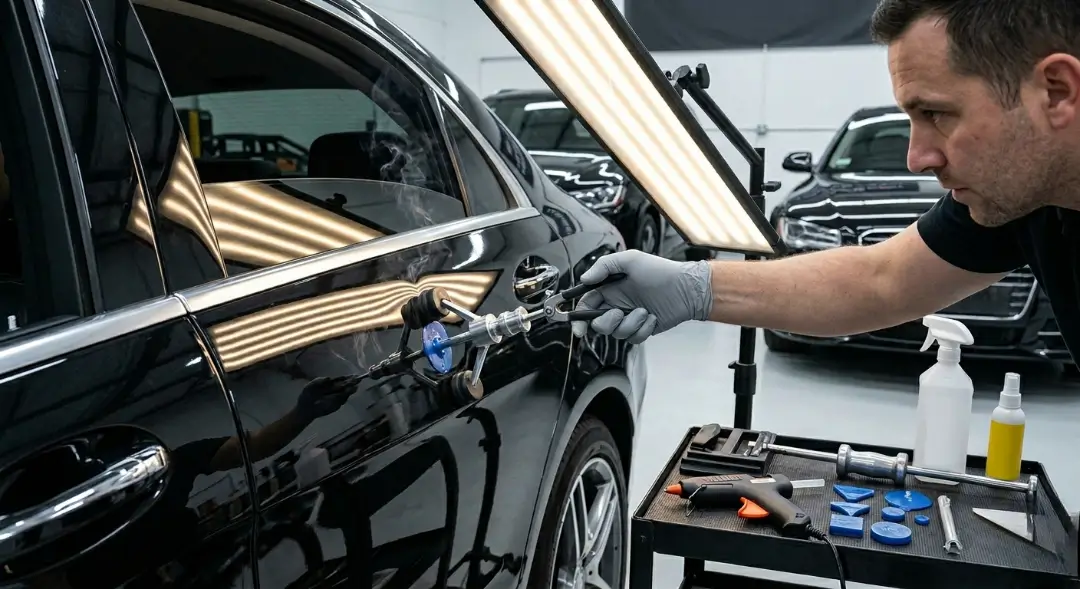
PDR uses controlled pushing or pulling to reshape suitable dents while retaining the existing painted finish. Access or tool contact may also require restoration of backside corrosion protection.
For eligibility limits, see whether all dents can be fixed without repainting.
2. The Traditional Dent Repair Process
Conventional dent repair may involve metal reshaping, part replacement, surface preparation, and refinishing. The required work depends on the damage and manufacturer procedures.
Key Decision Factors: PDR vs. Traditional Repair
Intact paint and limited stretching make PDR worth assessing, but they do not guarantee eligibility. Panel access, prior repairs, material, and nearby structural or safety components also matter.
1. Coating Integrity
PDR does not repair scratches, chips, or cracks in the finish. Damaged paint may need separate repair, even when the dent itself can be reshaped paintlessly.
2. Metal Stretch and Dent Shape
Dent repair involves controlled reshaping of the panel. Severe stretching, sharp folds, tears, and restricted access can limit PDR. The technician must assess whether the panel can be restored while preserving the finish and following the manufacturer’s repair requirements.
3. Repair Speed and Daily Convenience
PDR: Small, accessible dents may be completed quickly, while complex damage or extensive disassembly can take longer.
Conventional repair: Refinishing and replacement can add preparation, curing, parts, and scheduling time. Ask for an estimate based on the actual repair scope.
4. Existing Finish and Resale Value
PDR can preserve the existing finish when the dent qualifies. Conventional repair restores damaged areas when paintless repair is unsuitable.
Neither method guarantees a particular resale value. The original damage, repair quality, vehicle history, and buyer’s assessment all matter.
Can One Vehicle Require Both Methods?
Yes. One panel may have intact paint and a dent suitable for PDR, while another has damaged paint or deformation requiring conventional repair, refinishing, or replacement.
Combining methods allows the shop to address each panel’s condition while preserving the existing finish where practical.
Frequently Asked Questions
Is PDR always cheaper than traditional dent repair?
No. PDR can cost less when it avoids refinishing, but complex access, dent shape, panel material, and disassembly can change the comparison. Compare estimates for the appropriate repair scope rather than choosing by method alone.
For detailed local pricing ranges, review our Huntington Beach dent repair cost guide.
Does traditional dent repair ruin my car’s resale value?
No. Traditional repair does not automatically ruin resale value, but neither repair method guarantees that the original damage will have no effect on value.
Can hail damage be fixed with traditional body repair?
Some hail dents qualify for PDR; others require conventional repair or replacement. A panel-by-panel assessment determines the appropriate combination. Learn more in our guide to repairing hail damage without repainting.
Get an Expert Damage Evaluation in Huntington Beach
At ER Collision and Auto Body Shop in Huntington Beach, Erik Reyna and his team evaluate damage, paint condition, panel material, and access to recommend an appropriate repair method.
As an I-CAR Gold Class certified facility, we handle both precision Paintless Dent Repair and full-service traditional collision repair under one roof.
Contact us Today to Get Your Professional Dent Evaluation.