Yes. Many dents can be repaired from the exterior using glue pulling, a paintless dent repair technique that does not require a technician to place a rod directly behind the damaged area.
However, glue pulling is not appropriate for every dent. Its suitability depends on the paint condition, dent shape, metal tension, panel material, surface condition and repair limitations for the vehicle.
Some dents can be completed primarily through exterior pulling. Others require behind-the-panel pressure, and many complex repairs may benefit from carefully selected techniques at different stages.
What Is Glue Pulling?
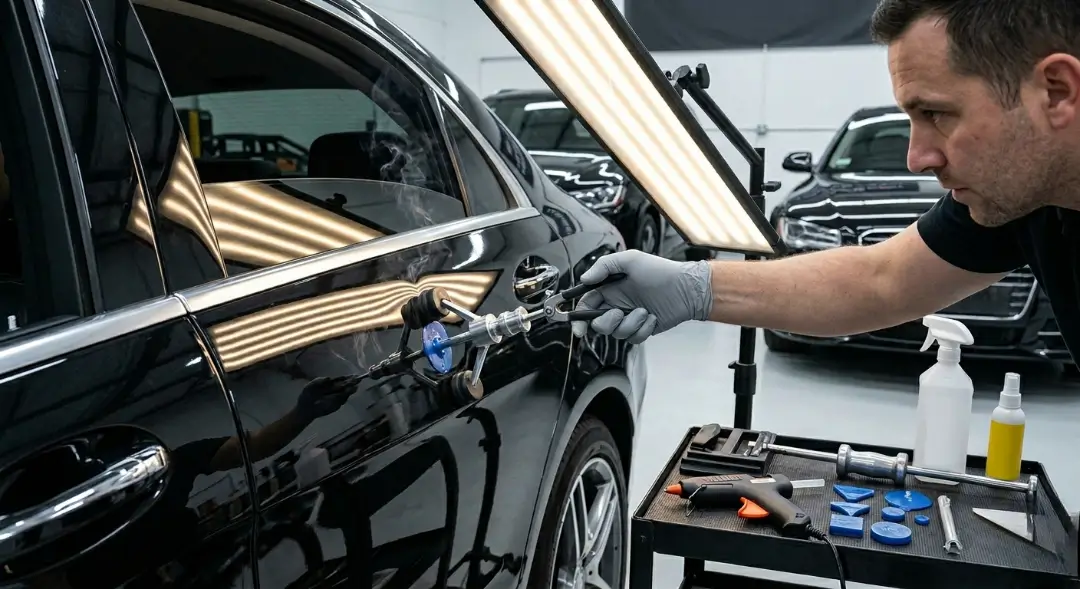
Glue pulling uses removable adhesive and purpose-designed tabs to move dented metal from the exterior surface.
A typical professional process may include:
- Inspecting the paint and damage under specialized lighting
- Cleaning and preparing the repair surface
- Selecting a tab that matches the dent’s size and shape
- Applying the appropriate adhesive
- Attaching the tab to the repair area
- Using a lifting device to apply controlled outward force
- Releasing and removing the tab
- Lowering raised areas and reassessing the panel
- Repeating the process as necessary
Professional glue-pull systems include tabs with different shapes, sizes, flexibility and pulling characteristics.
Tab selection affects how force is transferred into the panel. A round dent, long crease and broad area of displaced metal may each require a different repair strategy.
Glue Pull Repair training commonly includes damage analysis, metal flow, lighting, lateral tension, tab selection, surface preparation, pulling strategy and knockdown techniques.
KECO Glue Pull Repair training provides an example of this structured approach.
What Is Behind-the-Panel PDR?

Behind-the-panel PDR uses rods, hand tools or other purpose-designed equipment to apply controlled pressure from the reverse side of the dent.
When appropriate access exists, the technician can target specific low areas and make small adjustments while monitoring the exterior surface under PDR lighting.
Access may require the safe removal of:
- Interior door trim
- Trunk trim
- Wheel-well liners
- Lamps
- Limited interior components
- Other permitted removable parts
Rear access is not automatically the better method. The technician must consider whether disassembly is justified, whether the panel can be reached safely, and whether nearby wiring, reinforcements, airbags, sensors or bonded components affect the repair plan.
Glue Pulling vs. Behind-the-Panel PDR
| Repair consideration | Glue pulling | Behind-the-panel PDR |
|---|---|---|
| Primary working side | Exterior surface | Backside of panel |
| Rear access required | No direct rear access | Yes |
| Common advantage | Reaches blocked or inaccessible areas | Allows targeted pressure from behind |
| Common limitation | Adhesion and pulling control depend on surface and damage | Braces or components may block tool access |
| Typical tools | Adhesive, tabs and lifting devices | Rods and hand tools |
| Best use | Determined by dent shape, surface and access | Determined by access and damage geometry |
| Refinement | May require controlled tapping or additional pulls | May require controlled tapping or exterior support |
Neither technique is universally superior. The correct method is the one that moves the metal safely while protecting the paint and nearby components.
When Does Glue Pulling Work Well?
Glue pulling may be considered when:
- Paint remains intact and securely bonded
- Direct access behind the dent is restricted
- Removing interior components would be unnecessarily invasive
- A brace or second metal layer blocks rod access
- The dent’s shape is compatible with available tabs
- The exterior surface can be prepared for reliable adhesion
- Manufacturer repair information permits the procedure
Glue pulling can be used on more than small, shallow dents. Professional systems include tabs and pulling strategies designed for broad damage, creases and body-line areas.
Complex damage still requires a careful assessment, and exterior pulling alone may not produce the desired result in every case.
For body-line-specific limitations, see whether PDR can repair body-line dents.
When Is Behind-the-Panel Access Helpful?
Behind-panel tools may be helpful when:
- The dent contains concentrated low areas
- Precise pressure is needed at specific points
- Safe rear access is available
- The panel has complex curvature
- Exterior pulling cannot adequately control the remaining distortion
- The technician needs to refine the contour after the initial metal movement
The existence of rear access does not automatically mean it should be used. Removing trim near wiring, airbags, sensors or other components must be performed according to the vehicle’s applicable service and repair information.
Technicians should not drill access holes merely for convenience when the manufacturer prohibits or restricts that practice.
Can Both Methods Be Used on One Dent?
Yes. Some repairs may use glue pulling to move the initial low area and behind-the-panel tools for controlled refinement. Other dents may be completed using one method.
A combined approach can include:
- Exterior pulling to reduce dent depth
- Rod pressure to address remaining low areas
- Controlled tapping to lower raised spots
- Repeated lighting checks to monitor surface movement
The decision should be based on the dent—not a rule that every repair requires both methods.
What Factors Determine the Repair Method?
A professional technician evaluates:
Paint condition
Cracked, chipped, peeling or previously refinished paint may not tolerate adhesive pulling. Previous paintwork can behave differently from a factory finish.
Dent shape and depth
Broad dents, round dents, sharp creases and body-line damage transfer metal tension differently and may require different tools.
Panel access
Braces, reinforcements, double-wall construction and interior components may restrict rear access without necessarily making exterior pulling the only possible repair.
Panel material
Steel and aluminum respond differently during reshaping. The technician should identify the panel material and follow vehicle-specific repair limitations.
Surface condition
Wax, sealants, paint-protection film and ceramic coatings may affect surface preparation or tab adhesion. The correct procedure depends on the product, paint condition and proposed repair. Do not assume that every coating must be polished off.
Nearby components
Airbags, sensors, wiring, intrusion beams, bonded areas and factory attachments may affect whether disassembly, heat or tool placement is permitted.
Can Glue Pulling Damage Paint?
Glue pulling is designed for use on suitable painted surfaces, but paint damage remains possible when:
- The finish is already cracked or weakened
- The panel has been repainted
- The adhesive or tab is unsuitable
- Surface preparation is incorrect
- Pulling force is excessive
- Adhesive is removed improperly
- Repair conditions do not account for the paint and panel
Possible problems include clear-coat separation, paint lifting, raised areas, stretched metal and surface distortion.
There is no universal safe temperature that applies to every vehicle, paint system, adhesive, panel and repair location. Any heat use should account for product instructions, paint condition and manufacturer limitations.
Read more about whether PDR can damage automotive paint.
When Is Paintless Repair Not Appropriate?
Glue pulling or behind-the-panel PDR may not provide a complete repair when:
- Paint is cracked, chipped or separated
- The panel is torn or punctured
- Metal has been severely stretched
- A sharp fold has collapsed the panel
- A damaged edge or reinforcement is involved
- A safety-related component has been affected
- Previous body filler is present
- Manufacturer procedures require conventional repair or replacement
PDR-related techniques may sometimes be used to reduce damage before refinishing, but the completed repair would no longer be entirely paintless.
For a broader repair-method comparison, see paintless versus traditional dent repair.
Frequently Asked Questions
Can a dent be repaired without removing an interior panel?
Sometimes. Glue pulling can move eligible dents from the exterior, but repairability depends on the paint, dent geometry, surface condition and panel construction.
Is glue pulling as effective as behind-the-panel PDR?
Either method can be effective when correctly matched to the damage. Behind-panel tools offer targeted internal pressure, while glue pulling provides exterior access where rods cannot be used safely or efficiently.
Can glue pulling repair a sharp crease?
Some creases can be improved or repaired with specialized tabs and techniques. Deep folds, damaged paint or severely stretched metal may require another method.
Does a ceramic coating prevent glue pulling?
Not automatically. Coatings can affect adhesion and surface preparation, but the correct procedure depends on the coating, paint condition and repair system.
Can I perform glue pulling with a DIY kit?
Consumer kits may move a simple dent, but incorrect tab selection, adhesive, pulling force or finishing technique can damage paint or create high spots. A professional evaluation is safer for visible, complex or valuable panels.
Professional Dent Repair in Huntington Beach
At ER Collision and Auto Body Shop in Huntington Beach, CA, Erik Reyna’s team use advanced paintless dent repair techniques—including both glue pulling and traditional PDR—to deliver high-quality, precise results.
✔ 15+ years of experience
✔ I-CAR Gold Certified technicians
✔ Factory paint preservation
✔ Honest, expert assessments
Not sure which method your dent requires?
We’ll evaluate it and recommend the best approach for a clean, professional finish