If your car AC is blowing warm air instead of cold, it usually indicates a refrigerant, airflow, or compressor issue that requires professional car AC repair in Huntington Beach.
Warm air is not a “minor inconvenience.” It’s often an early warning sign that something in the cooling system is failing — and delaying repairs can turn a small issue into an expensive one.
At ER Collision and Auto Body Shop in Huntington Beach, our I-CAR Gold certified technicians have diagnosed and repaired vehicle climate systems for over 15 years. We focus on accurate diagnostics, not guesswork — because simply “recharging the AC” without identifying the root cause rarely fixes the problem.
Below, we break down the most common reasons your car AC blows warm air — and what to do next.
1. Low Refrigerant (Most Common Cause)
If refrigerant levels drop below specification, your system cannot absorb and release heat properly.
Why refrigerant becomes low:
- Small leaks in AC lines or hoses
- Worn O-rings or seals
- Compressor shaft seal wear
- Condenser damage
- Improper prior recharge
Modern vehicles use either R134a or R1234yf refrigerant, and both require proper pressure levels to function correctly.
Important: Refrigerant does not “run out.” If levels are low, there is usually a leak.
Preventive inspections can often identify small leaks before cooling performance drops — our Car AC Maintenance & Prevention Guide explains how routine service reduces long-term repair costs.
A simple recharge without leak repair may temporarily restore cooling — but the warm air will return.
2. AC Blows Cold While Driving, But Warm at Idle
This is one of the most searched car AC questions.
If your AC cools while driving but becomes warm when stopped, common causes include:
- Failing condenser fan
- Weak compressor
- Restricted condenser airflow
- Cooling fan electrical issues
- Low refrigerant pressure
In Huntington Beach traffic, extended idle time in warm weather can stress a marginal condenser fan. When airflow across the condenser drops, system pressure rises — and cooling performance decreases.
This issue requires pressure testing and fan diagnostics, not just refrigerant top-off.
3. Failing AC Compressor
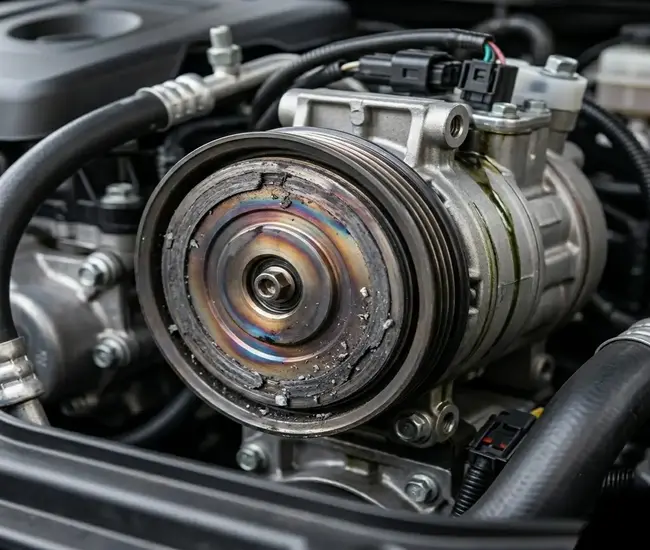
The compressor is the heart of your vehicle’s AC system.
Signs of compressor problems:
- Clicking or grinding noises
- AC clutch not engaging
- Intermittent cooling
- Warm air after short cooling period
If the compressor cannot maintain proper pressure differential, the system will not cool effectively.
If you’d like a clearer understanding of how pressure changes and refrigerant flow affect cooling performance, our guide explaining how a car AC system works breaks down the full heat-transfer cycle in simple terms.
At ER Collision and Auto Body Shop, we test:
- Compressor clutch engagement
- System pressure readings
- Electrical signals
- Internal compressor performance
We only replace compressors when confirmed faulty — not based on assumptions.
4. Electrical or Sensor Malfunction
Modern vehicles rely on HVAC control modules, relays, pressure switches, and sensors.
If your AC:
- Cycles on and off rapidly
- Does not respond to temperature changes
- Blows warm air intermittently
The issue may involve:
- Faulty pressure sensors
- Climate control module issues
- Blower motor resistor
- Blend door actuator failure
Electronic faults require diagnostic scanning and electrical testing.
5. Blocked or Damaged Condenser
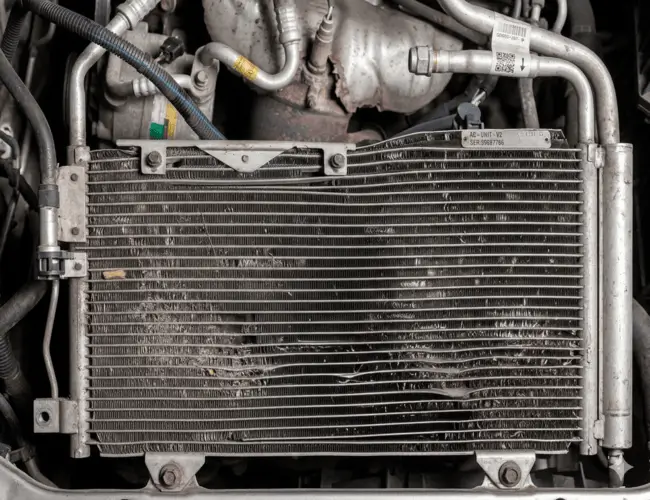
Your condenser sits near the front of the vehicle and is exposed to:
- Road debris
- Bugs
- Dirt buildup
- Minor front-end impacts
Restricted airflow reduces heat exchange efficiency and causes warm air output.
This is especially common in coastal areas like Orange County, where salt air and debris accelerate corrosion.
6. Cabin Air Filter Restriction
A severely clogged cabin air filter can reduce airflow across the evaporator.
Symptoms may include:
- Weak airflow
- AC feels cool but not cold
- Foggy interior windows
Replacing a cabin filter is a simple repair — but it should be part of a full diagnostic, not a guess.
Can I Fix Warm AC Air Myself?
This is a very common question.
You can safely:
- Check cabin air filter condition
- Inspect for visible debris on condenser
- Check basic fuse issues
You should NOT:
- Add refrigerant without pressure testing
- Attempt compressor replacement
- Open refrigerant lines
- Use stop-leak products
Improper refrigerant handling can damage the system and harm the environment.
According to EPA motor vehicle air conditioning (MVAC) system servicing requirements, technicians must be properly trained and use approved refrigerant handling equipment to recover and recycle refrigerants rather than venting them during automotive AC service.
Professional AC diagnostics ensure:
- Leak detection before recharge
- Correct refrigerant type
- Proper pressure levels
- Component verification
How Much Does It Cost to Fix Warm AC Air?
Costs vary depending on the cause.
Typical repair categories:
Minor repairs:
- Cabin filter replacement
- Sensor replacement
- Minor electrical repairs
Moderate repairs:
- Leak repair and recharge
- Condenser fan replacement
Major repairs:
- Compressor replacement
- Condenser replacement
- Evaporator replacement
We provide written estimates before starting any repair and explain exactly what failed and why.
Why Accurate Diagnostics Matter
Many shops immediately suggest:
“Let’s recharge it.”
But recharging a leaking or failing system does not solve the root issue.
Our approach includes:
- Refrigerant pressure testing
- Leak detection
- Compressor performance testing
- Electrical system verification
- Vent temperature measurement
With over 15 years of experience and I-CAR Gold certification, our Huntington Beach team prioritizes correct repairs the first time.
We also offer:
- OEM or OEM-equivalent components
- Written workmanship warranty
- Free pickup and delivery within 5 miles
- Car rental assistance if extended repair is needed
We understand that driving without working AC in Southern California heat isn’t comfortable — so we prioritize accurate, efficient service.
When Should You Schedule AC Service?
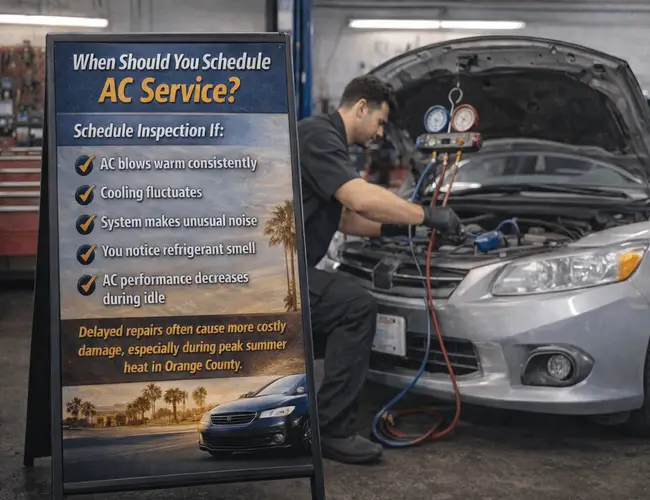
Schedule inspection if:
- AC blows warm consistently
- Cooling fluctuates
- System makes unusual noise
- You notice refrigerant smell
- AC performance decreases during idle
Delaying repairs often increases costs, especially if compressor damage occurs due to low refrigerant.
Seasonal inspections and proper airflow maintenance can significantly reduce the risk of sudden cooling failure — especially during peak summer temperatures in Orange County.
Frequently Asked Questions
Why is my car AC blowing warm air even after recharge?
A recharge without fixing leaks or pressure issues will not solve the root cause. Leak detection and system testing are required.
Why does AC work only when driving?
This often indicates airflow problems at idle, such as a failing condenser fan or weak compressor.
Is it safe to drive with warm AC?
Yes, but ignoring low refrigerant or compressor issues may lead to more expensive repairs.
How long does AC diagnosis take?
Most inspections take under one hour. Many repairs can be completed the same day depending on parts availability.
Professional Car AC Repair in Huntington Beach
If your AC is blowing warm air, accurate diagnostics are essential.
At ER Collision and Auto Body Shop, we provide professional car AC repair in Huntington Beach with a diagnostic-first approach focused on solving the real issue — not replacing unnecessary parts.
Serving drivers across Huntington Beach, Costa Mesa, Fountain Valley, and Newport Beach.
Schedule an AC inspection today and restore reliable cooling performance.
In addition to AC system repairs, we provide complete car mechanical repair services for drivers across Orange County.