If your vehicle makes a clunking or knocking sound when driving over bumps, potholes, or uneven pavement, the issue often originates in the suspension system.
Suspension components are designed to absorb impact while keeping your tires firmly connected to the road. When a part becomes worn or loose, it can create excess movement — which produces clunking noises under load.
Understanding the source of the sound helps prevent further component wear and handling instability. In many cases, suspension wear can also contribute to irregular tire patterns, which is why problems like clunking may appear alongside uneven tire wear.
What Does a Clunking Suspension Sound Like?
Drivers often describe it as:
- A dull knock from the front end
- A metallic clunk when hitting a bump
- A single thud when turning into a driveway
- A repeated knocking over rough roads
The sound may be more noticeable at low speeds or when one wheel encounters a bump independently.
Most Common Causes of Clunking Over Bumps
Worn Sway Bar Links
Sway bar links connect the sway bar to the suspension assembly.
When bushings or link joints wear out, excess play develops. As the vehicle shifts weight over bumps, the loose connection can create a knocking sound.
Sway bar link noise is often most noticeable on uneven roads.
Failing Ball Joints
Ball joints act as pivot points between control arms and steering knuckles.
When they wear:
- Vertical movement increases
- Steering geometry changes
- Impact noise becomes more noticeable
A worn ball joint may produce a clunk during bumps, braking, or turning.
Worn Control Arm Bushings
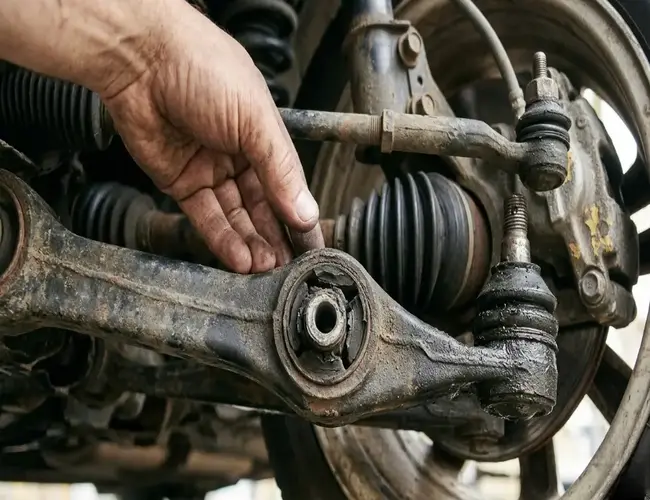
Control arm bushings cushion suspension movement and maintain wheel alignment.
Over time, rubber bushings crack or deteriorate. When this happens, the control arm can shift slightly under load, producing a dull clunk over bumps.
Bushing wear may also contribute to uneven tire wear and steering drift. According to AAA, worn suspension parts play a direct role in tire wear and performance.
Loose or Damaged Strut Mounts
Struts attach to the chassis through upper mounting assemblies.
If the mount or bearing plate wears out, movement at the top of the strut can cause knocking sounds during suspension compression.
This is often heard when driving over small bumps at lower speeds.
Worn Shock Absorbers or Struts
Shocks and struts control vertical movement of the suspension.
If damping weakens, components may move excessively during impact. While weak shocks usually cause bouncing rather than clunking, severe internal wear can create noise.
Loose Suspension Hardware
Improperly torqued bolts, worn mounting brackets, or damaged subframe components can create impact-related noise.
Even minor hardware looseness can produce noticeable sounds under road load.
When multiple systems are involved — including steering or drivetrain components — a full mechanical inspection may be required.
Can Clunking Be Caused by Steering Components?
Yes.
Tie rods and steering rack components also experience movement during bumps.
If tie rod ends become loose, steering linkage can produce a knocking sound while the suspension compresses.
This may also affect steering stability at higher speeds.
This may also affect steering stability at higher speeds and can contribute to problems like a vehicle pulling to one side while driving, which is another common symptom of front-end wear.
Why Does the Noise Happen Only on One Side?
Clunking often occurs on the side experiencing the most wear.
For example:
- A single worn sway bar link
- One deteriorated ball joint
- A control arm bushing on one corner
Uneven wear patterns are common due to road conditions and driving habits.
Is It Safe to Drive With a Clunking Noise?
Not all clunking indicates immediate danger — but it should not be ignored.
Loose suspension components can:
- Alter alignment angles
- Increase tire wear
- Reduce steering precision
- Stress neighboring parts
If the noise becomes louder, more frequent, or is paired with vibration or steering instability, inspection should not be delayed.
How Is a Clunking Suspension Diagnosed?
A proper suspension inspection includes:
- Checking for excessive movement at pivot points
- Inspecting sway bar links and bushings
- Testing ball joints under load
- Evaluating control arm movement
- Inspecting strut mounts
- Verifying torque specifications
If you’re experiencing these symptoms, it’s important to have a professional suspension repair service inspect the vehicle to accurately identify worn components and prevent further damage.
Accurate diagnosis identifies the exact source rather than replacing parts based on assumption.
Frequently Asked Questions
Why does my car clunk only at low speeds?
Low-speed bumps often create sharper suspension compression, which makes loose components more noticeable.
Can bad shocks cause clunking?
Severely worn shocks can contribute, but clunking more commonly involves bushings, ball joints, or sway bar links.
Is clunking expensive to fix?
Cost depends on the worn component. Replacing a sway bar link differs significantly from replacing control arms or steering components.
Why does my car clunk after hitting a pothole?
Impact can stress suspension parts, shift alignment geometry, or damage mounting hardware.
Suspension Inspection in Huntington Beach
If you hear clunking over bumps, a suspension inspection can determine whether the issue is minor wear or a developing mechanical problem.
At ER Collision & Auto Body Shop in Huntington Beach, Erik Reyna & his team having 15+ years of experience, evaluates suspension and steering systems to identify worn components and restore proper geometry.
Early diagnosis helps prevent larger repairs and protects handling stability.