Most drivers use their air conditioning daily, especially during Southern California heat — but many ask:
- “How does car AC actually work?”
- “Why does it cool better while driving?”
- “Why does it suddenly blow warm air?”
- “Does refrigerant get used up?”
Understanding the basics helps you recognize early warning signs before small issues turn into major repairs.
At ER Collision and Auto Body Shop in Huntington Beach, our I-CAR Gold certified technicians have provided professional car AC repair for over 15 years. We focus on accurate diagnostics, OEM-quality parts, and repairs done correctly the first time.
Below is a simple explanation of how your vehicle’s AC system works — and why problems occur.
The Basic Principle: Your AC Removes Heat, It Doesn’t Create Cold
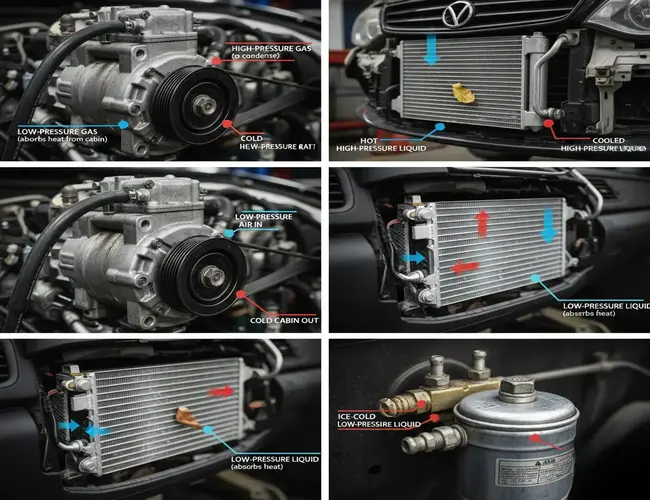
Your AC system works by:
- Absorbing heat from inside your cabin
- Transferring that heat outside
- Circulating refrigerant under pressure
If any part of this heat-transfer cycle fails, cooling performance drops.
If your system is already blowing warm air, you may want to read our detailed guide on why car AC systems lose cooling performance.
The 5 Main Components of a Car AC System
Modern automotive air conditioning systems rely on:
- Compressor
- Condenser
- Expansion valve (or orifice tube)
- Evaporator
- Refrigerant (R134a or R1234yf)
Each component depends on correct pressure levels and airflow.
The Compressor – The Heart of the System
The compressor pressurizes refrigerant and circulates it through the system.
If the compressor fails:
- AC may blow warm air
- You may hear clicking or grinding
- The AC clutch may not engage
Compressor issues are one of the most searched AC problems online.
Because replacing a compressor is a major repair, proper diagnosis is critical before replacement.
If you’re unsure about repair expenses, our full car AC repair cost guide explains what affects pricing.
The Condenser – Releasing Heat Outside
Located at the front of your vehicle, the condenser releases cabin heat.
This is why AC often works better while driving — airflow increases across the condenser.
If AC is cold while moving but warm at idle, airflow or condenser fan issues may be involved.
In coastal environments like Huntington Beach, debris and salt exposure can reduce condenser efficiency over time.
The Expansion Valve – Controlling Pressure
The expansion valve lowers refrigerant pressure before it enters the evaporator.
If restricted or clogged, cooling may feel inconsistent.
Drivers often describe this as:
- “AC starts cold then gets warm”
- “Air feels cool but not ice cold”
These symptoms frequently appear in discussion forums.
The Evaporator – Where Cooling Happens
The evaporator absorbs heat from cabin air.
Blower fans push air across the evaporator core, cooling the interior.
If airflow is weak, possible causes include:
- Clogged cabin air filter
- Blower motor issues
- Evaporator blockage
Refrigerant – The Heat Transfer Medium
Vehicles typically use:
-
R134a (older systems)
-
R1234yf (newer vehicles)
Refrigerant operates in a sealed system.
It does not “get used up.”
If refrigerant is low, there is usually a leak.
Recharging without confirming leaks can result in temporary cooling only.
For accurate system testing, professional car AC repair in Huntington Beach ensures proper pressure verification and leak detection.
Why Understanding System Operation Matters
Understanding how your AC system operates makes preventive maintenance more effective. When drivers recognize early pressure imbalances, airflow restrictions, or refrigerant issues, they can address minor problems before major components fail.
If you want to reduce the risk of unexpected breakdowns, our Car AC Maintenance & Prevention Guide explains simple steps that help extend system life and prevent costly compressor damage.
Many drivers search online and assume:
- “It just needs a recharge.”
- “Compressor must be bad.”
- “AC systems fail randomly.”
In reality, cooling failure is almost always linked to:
- Pressure imbalance
- Airflow restriction
- Electrical malfunction
- Refrigerant leakage
At ER Collision and Auto Body Shop, we use:
- Pressure testing
- Leak detection
- Compressor performance checks
- Electrical diagnostics
- Vent temperature verification
With over 15 years of experience, I-CAR Gold certification, OEM-equivalent parts, free pickup & delivery within 5 miles, and rental car assistance, we prioritize correct repairs over guesswork.
Frequently Asked Questions Drivers Ask
Why does AC work better while driving?
Increased airflow across the condenser improves heat release.
Does refrigerant get used up?
No. If levels are low, there is typically a leak.
Why does AC smell musty?
Moisture buildup in the evaporator can allow mold growth.
Should I run AC during winter?
Yes. Running it occasionally keeps seals lubricated and prevents drying.
When to Schedule Professional Inspection
Schedule service if:
- Cooling performance drops
- AC cycles rapidly
- Warm air appears intermittently
- Noises develop
- Cooling fails at idle
Early inspection prevents larger repair costs later.
Professional Car AC Repair in Huntington Beach
If your system is not cooling properly, professional diagnostics are essential.
Our Huntington Beach technicians provide complete AC system diagnostics and repair backed by a workmanship warranty and 15+ years of experience.
Schedule an inspection today to restore reliable cooling performance.
In addition to AC diagnostics and repair, we provide complete car mechanical repair services for drivers throughout Huntington Beach and surrounding Orange County communities.