A shock absorber is a standalone damping component that controls spring and suspension movement.
A strut provides damping but also serves as a structural part of the suspension assembly and may influence wheel alignment.
Both help control bouncing, maintain tire contact and stabilize the vehicle during braking and cornering.
However, shocks and struts are not interchangeable. A vehicle may use shocks, struts or a combination of both.
Shocks vs. Struts at a Glance
| Feature | Shock absorber | Strut |
|---|---|---|
| Controls bouncing | Yes | Yes |
| Structural suspension component | Generally no | Yes |
| Commonly part of a coil-spring assembly | No | Often |
| May affect alignment when removed | Usually no | Often |
| Replacement complexity | Usually lower | Usually higher |
| Commonly replaced in axle pairs | Yes | Yes |
The exact design and replacement procedure depend on the vehicle’s suspension configuration.
What Do Shocks and Struts Do?
Vehicle springs support weight and allow the wheels to move over bumps. Shocks and struts control the resulting spring movement so the vehicle does not continue bouncing after an impact.
- Proper suspension damping contributes to:
- Consistent tire contact
- Controlled movement over bumps
- Predictable steering response
- Reduced body movement through turns
- Controlled front-end dive during braking
- Improved ride comfort
Weak damping may allow excessive wheel movement and contribute to cupped or scalloped tire wear. Other patterns, including inside-edge wear, outside-edge wear and feathering, may involve tire pressure, wheel alignment or worn steering components.
Learn more about what causes uneven tire wear.
What Is a Shock Absorber?
A shock absorber—commonly called a shock—is normally a standalone hydraulic damping component.
Its primary functions are to:
- Control vertical suspension movement
- Reduce repeated bouncing
- Limit excessive body movement
- Help maintain tire contact
A conventional shock generally does not position the wheel or form the main structural connection between the wheel assembly and vehicle body. It works with springs, control arms and related suspension components.
Because shocks do not normally determine wheel position, replacing them may not affect alignment. Requirements depend on the vehicle and whether other suspension parts are disturbed.
What Is a Strut?
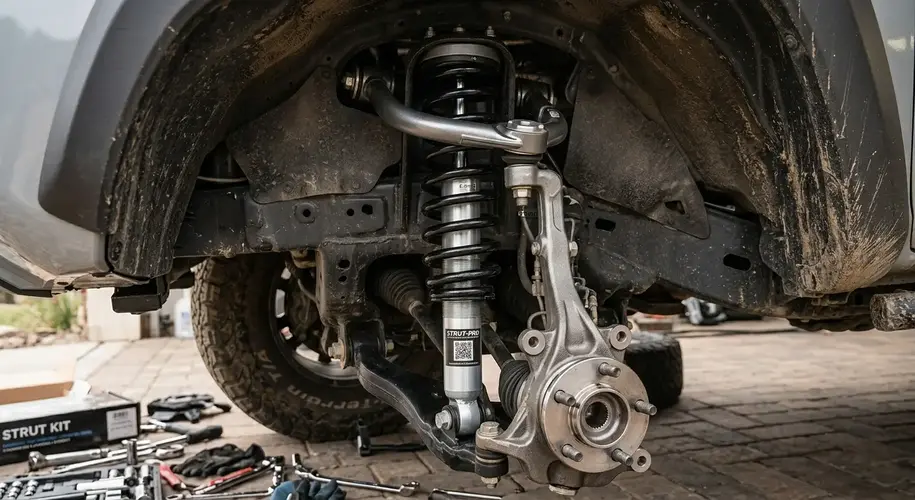
A strut combines damping with a structural suspension role.
Depending on the design, it may:
- Connect the steering knuckle or wheel assembly to the vehicle body
- Help position the wheel
- Form part of an assembly that includes or supports a coil spring
- Control suspension movement
- Influence alignment geometry
In many front MacPherson-strut systems, the steering knuckle attaches directly to the strut.
Removing or replacing it may therefore affect wheel position, camber or toe measurements.
Loss of damping alone does not necessarily change alignment. Geometry is more likely to be affected by a bent strut, damaged mount, incorrect ride height or movement at an attachment point.
Does Every Vehicle Have Shocks and Struts?
No. Suspension configuration varies by vehicle.
Common layouts include:
- Front struts and rear shocks
- Struts at all four corners
- Shocks at all four corners
- Different front and rear suspension designs
A vehicle does not normally use a separate shock and strut at the same wheel because both perform a damping function. The correct configuration can be confirmed through vehicle-specific repair information or physical inspection.
What Are the Signs of Worn Shocks or Struts?
Possible symptoms include:
- Continued bouncing after a bump
- Excessive body movement through turns
- Front-end diving during braking
- Rear-end squat during acceleration
- Fluid leaking from a shock or strut
- Cupped or scalloped tire wear
- Reduced stability on rough roads
- A loose or uncontrolled ride
- Visible impact damage
Clunking does not always mean the shock or strut itself has failed. The noise may originate from a strut mount, sway-bar link, ball joint, control-arm bushing, spring or loose hardware.
Review the common causes of clunking over bumps for related possibilities.
Do Struts Affect Steering and Alignment?
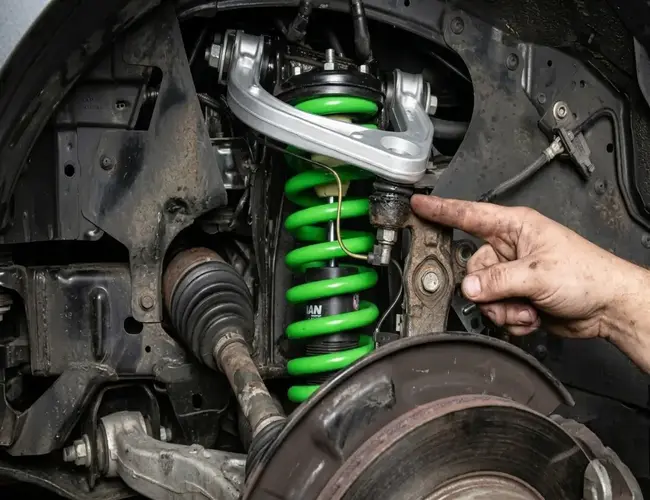
They can. In many front-suspension designs, the strut connects to the steering knuckle and helps establish wheel position.
A bent strut, damaged mount or loose attachment may contribute to:
- Pulling or drifting
- A crooked steering wheel
- Inconsistent steering response
- Alignment measurements outside specification
- Uneven tire wear
If a vehicle requires constant steering correction, the cause could also involve tire pressure, tire condition, tie rods, control arms, brake drag or structural movement.
Read why a car may pull to one side.
Why Do Struts Usually Cost More Than Shocks?
Struts usually cost more because they are structural components and are often more involved to remove and install.
Strut replacement may require:
- Disconnecting the steering knuckle
- Removing related brackets and hardware
- Inspecting the upper mount and bearing
- Transferring the original coil spring
- Installing a complete preassembled strut
- Verifying alignment afterward
Spring compression is necessary when the original coil spring must be transferred. A complete preassembled or “loaded” strut may include the spring and upper mount.
Shocks are often simpler to replace because they usually attach through upper and lower mounting points and do not position the wheel.
For local planning ranges, see our suspension repair and replacement cost guide.
Is Alignment Required After Replacement?
Alignment is commonly recommended after strut replacement because removing the strut can affect wheel position.
Alignment may not be required when conventional shocks are replaced and no geometry-related parts are disturbed. Verification may still be appropriate when:
- The vehicle pulls or drifts
- Tires are wearing unevenly
- The steering wheel is off-center
- A curb, pothole or collision caused the damage
- Control arms, tie rods or ball joints were replaced
Alignment can correct adjustable wheel angles, but it cannot repair a bent, worn or loose component.
Should Shocks and Struts Be Replaced in Pairs?
Shocks and struts are generally replaced in left-and-right axle pairs to maintain balanced damping.
Replacing only one side while leaving a significantly worn component on the other may create uneven suspension response. The final recommendation should depend on component condition, vehicle design and manufacturer procedures.
There is also no universal replacement mileage. Inspection should be based on leakage, physical damage, excessive bouncing, handling changes, tire wear and vehicle-specific guidance.
Can a Collision or Pothole Damage Shocks or Struts?
Yes. A direct wheel impact can damage a shock, strut, mount, steering knuckle, control arm or suspension attachment point.
Warning signs after an impact include:
- Sudden pulling
- A crooked steering wheel
- New vibration
- Clunking or grinding
- Tire rubbing
- Fluid leakage
- A noticeable handling change
Suspension damage may exist even when little exterior body damage is visible. This makes the topic directly relevant to collision and road-impact repair.
Frequently Asked Questions
Are shocks and struts the same?
No. Both control suspension movement, but a strut is also a structural suspension component.
Can a vehicle have shocks and struts?
Yes. Many vehicles use struts on one axle and shocks on the other.
Do new shocks require alignment?
Not always. Conventional shock replacement may not disturb wheel geometry. Strut replacement is more likely to require alignment verification.
Can worn shocks cause uneven tire wear?
Weak damping may contribute to cupping or scalloped wear. Tires, wheel balance, alignment and other suspension components should also be inspected.
How do I know which component my vehicle has?
The suspension layout can be identified using vehicle-specific repair information or a physical inspection.
Shocks and Struts Inspection in Huntington Beach
If your vehicle bounces, pulls, clunks, wears tires unevenly or feels unstable, an inspection can determine whether the problem involves shocks, struts or another component.
At ER Collision & Auto Body Shop in Huntington Beach, Erik Reyna and his team bring more than 15 years of repair experience.
Our suspension repair and replacement service includes inspection of damping components, mounting points and related alignment concerns.
When damage may be connected to a covered incident, we can document relevant findings and assist with insurance-claim repair coordination. Coverage depends on the policy and insurer’s determination.