If your vehicle drifts left or right when driving straight — especially when you briefly loosen your grip on the steering wheel — something in the steering or suspension system may be out of balance.
Car pulling is not normal. Even slight directional drift can indicate uneven tire wear, alignment issues, or worn suspension components that may require professional mechanical repair.
Understanding the cause helps you prevent uneven tire damage and maintain safe handling.
What Does “Car Pulling” Actually Mean?
Car pulling typically feels like:
- Needing constant steering correction
- Vehicle drifting when the wheel is centered
- Steering wheel slightly off-center
- Subtle tugging sensation at highway speeds
The issue may appear gradually or suddenly after hitting a pothole, curb, or road debris.
Most Common Causes of a Car Pulling to One Side
Wheel Alignment Out of Specification
Wheel alignment refers to camber, caster, and toe angles.
If these angles shift outside factory tolerances, your vehicle may drift left or right.
Common causes include:
- Road impact
- Suspension wear
- Control arm movement
- Subframe shift
Alignment adjustments correct geometry — but only if underlying components are intact. If suspension hardware is worn or damaged, suspension repair may be required before alignment can properly hold.
Uneven Tire Pressure
One of the simplest causes of pulling is uneven tire pressure.
If one front tire is underinflated, the vehicle may drift toward that side.
Checking tire pressure should always be the first step.
According to AAA, pulling to one side while driving at a steady speed may indicate an underinflated tire on the side to which the vehicle pulls.
Uneven Tire Wear
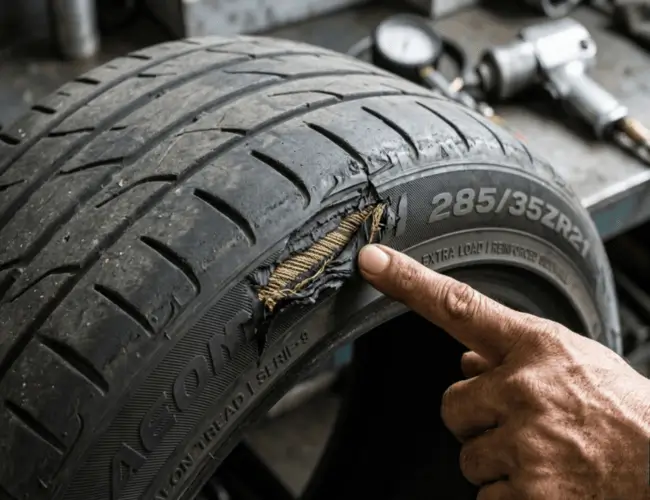
Tires worn more on one edge can affect directional stability.
Inside or outside edge wear may indicate:
- Camber imbalance
- Toe misalignment
- Worn suspension bushings
Severely uneven tires may continue pulling even after alignment is corrected.
If you’re noticing irregular tread patterns, it’s important to understand what causes uneven tire wear, as tire condition and suspension health are closely connected.
Worn Tie Rods or Steering Components
Tie rods connect the steering rack to the wheels.
If they become loose or worn, steering input may feel inconsistent and directional control can shift under load.
This often causes:
- Wandering at highway speeds
- Loose steering feel
- Delayed response when correcting direction
Control Arm or Bushing Wear
Control arms position the wheels under the vehicle.
Worn bushings can allow excess movement, altering alignment angles while driving.
This type of pulling may worsen during braking or acceleration and can sometimes be accompanied by noise — such as knocking or clunking — especially over bumps. If you’re hearing sounds along with pulling, it may be related to what causes clunking noise over bumps.
Brake Drag on One Side
A sticking brake caliper can create resistance on one wheel.
If one side experiences more braking force than the other, the vehicle may pull during braking.
This feels different from constant drift while cruising.
Road Crown Effect
Most roads are slightly angled to allow water runoff.
On certain roads, this can create a mild directional drift.
If pulling disappears on flat pavement, road crown may be contributing.
Persistent pulling across different roads usually indicates mechanical imbalance.
Is It Dangerous If My Car Pulls to One Side?
It can be.
Directional instability may:
- Reduce steering predictability
- Accelerate tire wear
- Affect braking stability
- Increase driver fatigue on long drives
- While minor drift is not always an emergency, it should be inspected before it worsens.
Can an Alignment Fix Car Pulling?
Sometimes — but not always.
If pulling is caused purely by alignment angle changes, a professional alignment may correct it.
However, if components like:
- Tie rods
- Ball joints
- Control arms
- Subframe mounts
are worn or damaged, mechanical repair must occur before alignment.
Alignment cannot compensate for loose hardware, especially when key components like shocks or struts are no longer controlling suspension movement effectively. Understanding the difference between shocks vs. struts can help clarify how these parts influence ride stability and steering control.
Why Does My Car Pull After Hitting a Pothole?
Road impact can shift suspension geometry or bend components.
Even if damage is not visibly obvious, minor angle changes can alter steering behavior.
Pothole-related pulling often appears suddenly.
How Is Steering Pull Diagnosed?
A proper inspection includes:
- Tire pressure verification
- Tire wear evaluation
- Suspension component inspection
- Steering linkage testing
- Alignment angle measurement
Accurate diagnosis identifies whether the issue is alignment-related, wear-related, or impact-related.
Frequently Asked Questions
Why does my car pull to the right but alignment is fine?
There may be worn suspension components, uneven tire wear, or brake drag causing the issue.
Can bad suspension cause pulling?
Yes. Worn control arms, bushings, ball joints, or tie rods can affect alignment angles under load.
Does tire rotation fix pulling?
If uneven tire wear is contributing, rotation may reduce the sensation — but underlying alignment issues must still be addressed.
Is it safe to drive if my car pulls slightly?
Short distances may be manageable, but persistent pulling should be inspected to prevent uneven tire damage.
Suspension & Steering Inspection in Huntington Beach
If your vehicle drifts, wanders, or requires constant correction, a mechanical inspection can identify the root cause.
At ER Collision & Auto Body Shop in Huntington Beach CA, Erik Reyna & his team having 15+ years of experience, performs inspection-driven suspension and steering diagnostics to restore proper geometry and directional stability.
Addressing steering pull early helps protect tire life, braking control, and overall handling performance.