ADAS calibration is required after auto body repair when the manufacturer specifies it for the work performed. This may include repairs involving cameras, radar sensors, their mounting points, or changes to vehicle geometry.
Inspection or calibration may be necessary even when no dashboard warning appears.
The repair facility should identify the affected systems and check their requirements rather than assume every repair needs calibration—or that an undamaged-looking sensor needs no attention.
If your vehicle recently underwent body repair, explore post-repair ADAS calibration services in Huntington Beach.
Which Repairs May Trigger Calibration?
Windshield replacement, camera or radar replacement, and certain bumper, suspension, or alignment repairs may trigger calibration requirements, depending on the vehicle manufacturer’s instructions.
| Repair operation | System or requirement to check |
|---|---|
| Windshield replacement | Forward-camera installation and calibration |
| Bumper cover or grille removal | Relevant front or corner radar requirements |
| Collision near a sensor | Sensor, mounting, wiring, and surrounding structure |
| Suspension repair or wheel alignment | Applicable steering-angle and ADAS procedures |
| Mirror replacement | Equipped camera systems |
| Camera or radar replacement | Installation, initialization, aiming, and calibration |
Use the I-CAR OEM Calibration Requirements Search as a reference for possible requirements. Performing the work still requires the vehicle’s current service instructions.
If concerns arise after windshield replacement, learn about potential ADAS calibration problems involving windshield glass.
Wheel alignment does not trigger the same follow-up procedures on every vehicle. Where the manufacturer requires steering-angle initialization or ADAS calibration, the shop should identify and document those operations separately.
7 Reasons to Have Your ADAS Checked
The following warnings, behavior changes, or recent repairs warrant assessment. They can have causes other than miscalibration.
- Dashboard warnings: Messages such as “Front Camera Unavailable,” “Driver Assist Limited,” or “Calibration Required.”
- Changed lane assistance: Unexpected intervention or inconsistent lane recognition under suitable conditions.
- Unusual collision alerts: Warnings or braking that behave differently after repair.
- Adaptive cruise control problems: Repeated disengagement or unexpected changes in operation.
- Inconsistent blind-spot alerts: Alerts that remain active or fail to appear as expected.
- Distorted surround-view images: Misaligned image stitching or an off-center camera display.
- Relevant repair history: Recent windshield, bumper, camera, radar, suspension, or alignment work.
Record the message and when the issue began. Do not deliberately trigger automatic emergency braking or lane intervention to test the system.
Why No Warning Light Does Not Establish Correct Calibration
A sensor may communicate with its control module without confirming that its aim or installation meets specifications. Warning behavior also varies by vehicle and system.
The absence of a warning or fault code does not cancel a manufacturer-required procedure. The relevant question is: What does the service information require after this repair?
A diagnostic scan and calibration perform different tasks. A scan identifies reported faults; it does not replace a calibration required by the manufacturer.
Why Precision Matters in ADAS Calibration After Body Repair
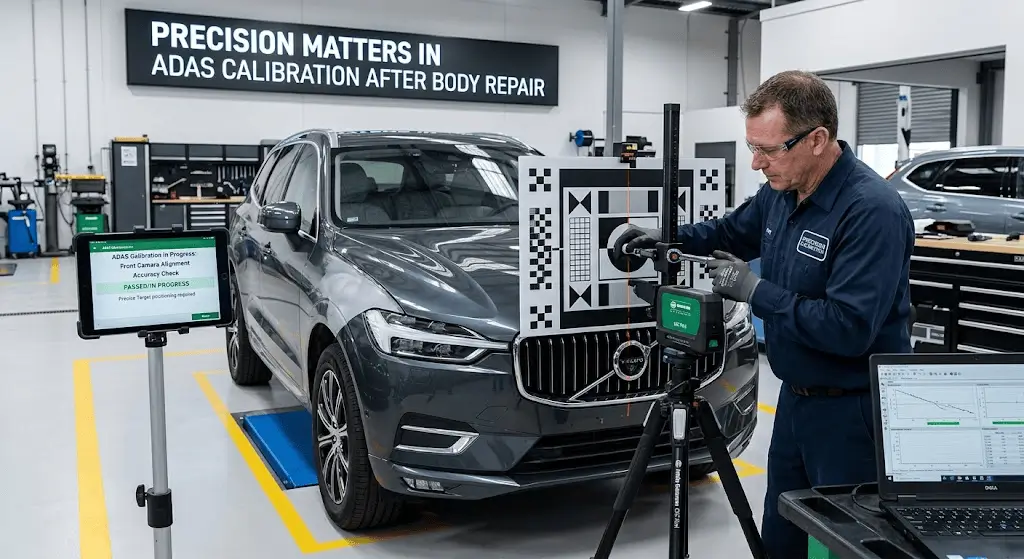
Precision matters because even a small change in a camera or radar sensor’s position can affect how the system detects objects after a collision or body repair.
Calibration helps establish the references the system uses to interpret its surroundings. It does not straighten damaged brackets or correct an improperly installed component.
The manufacturer’s procedure specifies the relevant mounting checks, setup conditions, and tolerances; there is no universal acceptable offset for every ADAS system.
Which Measurements Matter?
The manufacturer’s procedure identifies the references and tolerances required for the affected system. Depending on the system, it may require static calibration, dynamic calibration, or both.
| Measurement or condition | Why it matters |
|---|---|
| Specified vehicle reference line | Establishes the reference for target positioning or sensor aiming |
| Target distance, height, and angle | Places the calibration reference where the procedure requires it |
| Floor levelness and slope | Can affect the relationship between the vehicle and target |
| Ride height and vehicle load | May change the sensor’s height or orientation |
| Wheel alignment and thrust angle | May be relevant to preparation or aiming requirements |
| Sensor bracket position and condition | Determines whether the sensor is mounted correctly |
Not every procedure uses every measurement. There is no single target distance, floor tolerance, or reference line that applies to all vehicles.
Why Mounting Damage Must Be Corrected Before Calibration
If a collision damages a sensor bracket or changes a relevant mounting point, the technician must assess and correct that condition before proceeding.
Running a calibration routine does not establish that damaged hardware is acceptable. Likewise, repeatedly restarting an unsuccessful routine is not a substitute for checking the installation, measurements, equipment, and vehicle preparation.
What Should You Ask Your Body Shop About ADAS Work?
Ask the shop to explain and document:
- Affected systems: Which cameras, radar sensors, or other ADAS components were affected, and what repair triggered the required procedure?
- Preparation and corrective work: Were relevant mounting points inspected, damage corrected, and any required alignment or vehicle preparation completed?
- Calibration results: Which procedures were performed, who completed them, and what were the results?
- Remaining issues: Are any repair-related faults or required procedures unresolved?
Request the calibration results, including those from another provider if the work was subcontracted.
For general estimates, authorization, invoices, and recordkeeping, see the California Bureau of Automotive Repair’s documentation requirements.
Confirm Your Vehicle’s ADAS Requirements After Repair
At ER Collision and Auto Body Shop in Huntington Beach, Erik Reyna and his team bring more than 15 years of collision repair experience.
Contact us to discuss your repair history and the inspection or calibration procedures applicable to your vehicle.