Mobile ADAS calibration may be possible if the manufacturer’s procedure permits the proposed environment and the provider can meet all equipment, setup, and operating requirements.
Dynamic calibration requires specified driving conditions. Static calibration may require precise target placement, suitable floor conditions, adequate space, and controlled surroundings.
A mobile windshield replacement does not automatically mean every manufacturer-required ADAS calibration procedure can be completed in the same driveway.
Will Replacement and Calibration Happen at the Same Location?
Not necessarily. A provider may replace the windshield at your home and complete calibration elsewhere.
Before booking, confirm where each required stage will happen and whether a separate appointment or vehicle transport is needed.
If calibration requires a separate facility visit, explore our ADAS calibration services in Huntington Beach.
What Can Make a Driveway Unsuitable for Static Calibration?
A driveway may be unsuitable because of floor slope, uneven surfaces, insufficient space, unsuitable lighting or nearby objects, or difficulty keeping targets stable. The applicable limits depend on the manufacturer’s procedure.
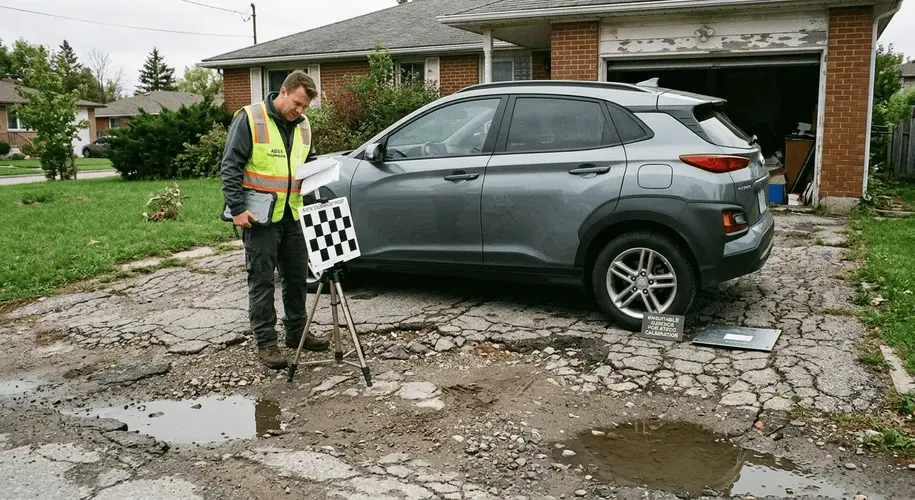
Floor Slope and Surface Conditions
Some procedures specify floor levelness or the relationship between the vehicle and targets. A sloped driveway, uneven paving, or changes in elevation can prevent the required setup.
There is no universal acceptable driveway slope for every vehicle. Ask how the technician checks the surface against your vehicle’s requirements.
Insufficient Clearance
The setup may require a particular distance in front of, behind, or beside the vehicle. Walls, parked cars, landscaping, or street boundaries can limit that space.
An area large enough to replace the windshield may still be too small for the prescribed calibration.
Lighting, Shadows, and Reflections
Certain camera procedures have requirements concerning lighting and the target’s surroundings. Direct sunlight, changing shadows, or reflections may affect the setup.
Radar procedures can have different restrictions involving nearby objects. The provider should assess the requirements for the actual sensor being calibrated.
Target Stability
Where targets or reflectors are required, they must remain in their specified position. Wind or an unstable stand can make that harder to maintain.
A provider should explain how the setup is measured and kept stable rather than rely on an assumption that outdoor conditions are acceptable.
I-CAR’s static calibration guidance explains why required tools, floor space, vehicle preparation, and precise target setup must be checked against the manufacturer’s procedure.
Is an Indoor Bay Automatically Better?
An indoor workspace can make some conditions easier to control, but being indoors does not establish compliance by itself.
The technician still needs the correct equipment, measurements, preparation, and instructions. The useful comparison is between setups that meet the procedure and those that do not.
Can Dynamic Calibration Be Completed During the Mobile Appointment?
Yes, if the provider includes dynamic calibration and can meet the manufacturer’s specified driving conditions during the appointment. The procedure takes place while driving, rather than while the vehicle remains parked in your driveway.
Traffic or visibility conditions may prevent completion during the scheduled visit.
For the technical differences between stationary and driving procedures, see our static and dynamic calibration guide.
What If the Driveway or Road Conditions Do Not Meet Requirements?
Before booking, confirm the fallback arrangement if onsite calibration cannot be completed. This may involve a suitable facility, another appointment, or a separate calibration provider.
Clarify:
- Who arranges the alternative location or appointment.
- Whether transport or a repeat visit costs extra.
- Who provides vehicle-specific guidance about use or transport.
What Should You Receive Before the Technician Leaves?
Before the technician leaves, confirm whether every required stage was completed and request the available calibration records.
If work remains unfinished, obtain a written handoff identifying:
- The completed and outstanding procedures.
- The condition that prevented completion.
- The provider responsible for the next step.
- Any agreed appointment, charges, and vehicle-use instructions.
Keep this handoff with the glass installation invoice.
Questions to Ask Before Booking Mobile Service
- Which procedure applies to my vehicle?
- Does my quote include ADAS calibration costs for every required stage?
- How will you assess my driveway?
- Will any work happen at another facility?
- Who will perform calibration, and do they have the training, equipment, and current instructions needed for my vehicle?
- What happens if conditions prevent completion?
- What records will I receive?
Answers should explain the procedure and arrangements rather than simply promise that all vehicles can be calibrated onsite.
Plan Your Windshield Replacement and Calibration Together
Contact ER Collision and Auto Body Shop in Huntington Beach to discuss windshield replacement and auto glass services and the calibration requirements for your vehicle.
If a mobile appointment left calibration unfinished, share your installation invoice and attempted-calibration records so we can discuss the next step.