Auto dent repair in Huntington Beach generally ranges from $95 to $1,000+ for panel repairs, while full panel replacement may costs $500 to $4,000+.
Because every vehicle’s construction and impact geometry differ, a physical inspection is required to determine the exact method and final cost. Below is a detailed breakdown of local pricing structures, cost factors, and repair-versus-replacement economics.
Estimated Dent Repair Cost Matrix
The total cost depends primarily on whether your vehicle qualifies for Paintless Dent Repair (PDR) or requires conventional body repair and refinishing.
| Repair Method & Damage Type | Estimated Cost Range | Common Application |
| Small Qualifying PDR Dent | $95 – $250 per dent | Door dings and shallow impressions with intact paint. |
| Complex or Larger PDR | Inspection required (typically $250 – $750+) | Body lines, aluminum panels, restricted rear access, or multiple dents. |
| Conventional Repair with Refinishing | $300 – $1,000+ per panel | Dents with cracked paint, deep metal stretch, or sharp folds. |
| Panel Replacement with Required Installation and Refinishing | $500 – $4,000+ | Severe metal stretching, torn/punctured panels, or structural damage. |
These all are planning estimates, not fixed quotes. Final pricing depends on inspection findings, labor, parts, refinishing, and any required scans or calibrations.
Which Dent Repair Method Costs the Least?
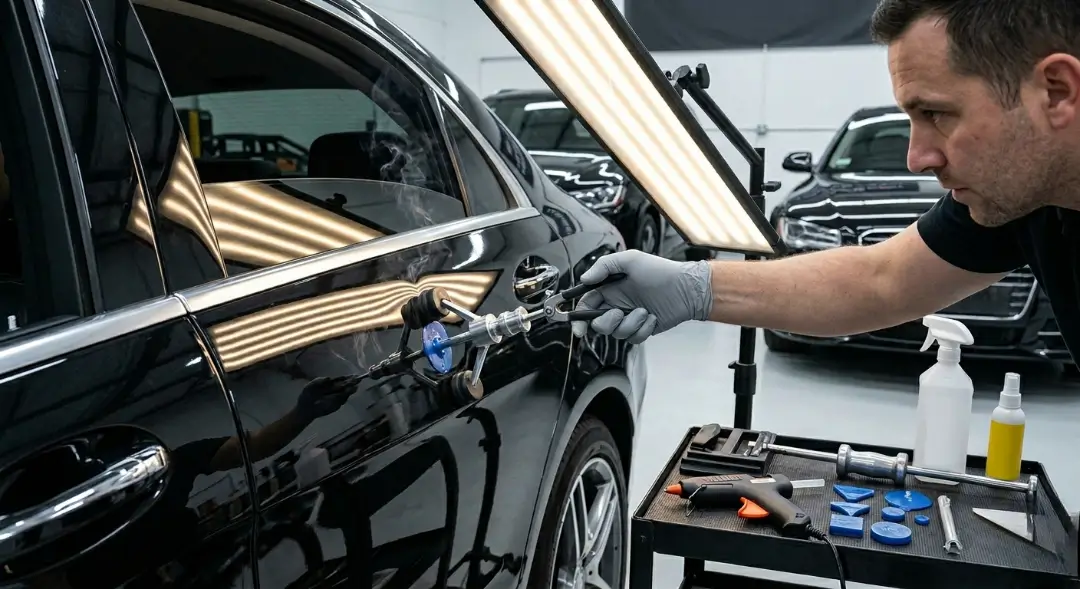
When damage qualifies, Paintless Dent Repair (PDR) is usually the most economical solution because it avoids body filler, sanding, primer, color matching, and full-panel repainting.
PDR is typical when:
- Factory paint remains securely bonded.
- Metal is not torn or severely stretched.
- The dent does not contain an extremely sharp fold.
- Safe backside tool access or glue-pulling access is available.
- Manufacturer procedures permit the method.
Conventional Repair or Refinishing May Be Needed When:
- Paint is cracked, chipped, peeling, or separated.
- Metal requires structural straightening or filler.
- Surface preparation, primer, corrosion protection, paint blending, and reassembly are necessary.
Unsure whether your dent qualifies? See which dents can be fixed without repainting.
What Factors Affect Your Car Dent Repair Estimate?
Dent Size, Depth, and Geometry: A broad, shallow dent is easier to correct than a narrow, deep crease across a body line.
Steel vs. Aluminum Panels: Aluminum panels can require different repair techniques and additional labor. The difficulty depends on the alloy, panel design, dent shape, and access
Location & Accessibility: Dents near panel edges, door seams, wheel openings, braces, or double-wall construction restrict tool access and may require additional disassembly.
Required Disassembly: Removing interior door cards, tail lights, moldings, or liners adds labor time. Some fasteners, clips, or adhesives may need replacement according to the applicable repair procedure
Previous Bodywork: Existing filler, repainted surfaces, or prior repair damage may change the available methods, paint risk, and labor required.
Do Cameras and ADAS Sensors Increase Repair Costs?
They can. Additional costs may apply if the damage or repair affects a camera, sensor, mounting area, or related component.
If the repair affects a camera, sensor, its mounting area, or related components, the shop should check the vehicle manufacturer’s procedures for any required inspections, scans, or calibration. A complete estimate will state whether scanning or calibration is required for your specific vehicle.
Repair vs. Replace: Which Is Better for Your Budget?
Panel Repair is recommended when metal stretch is limited, mounting points remain square, and manufacturer limits permit restoration.
Panel Replacement is recommended when metal is torn, severely stretched, structural reinforcements are compromised, or repair labor exceeds replacement part costs. Replacement estimates include part costs, installation, refinishing, paint blending, and corrosion protection restoration.
For a closer comparison of repair methods, read PDR vs. traditional dent repair.
Frequently Asked Questions
How much does a small door ding cost?
A qualifying small door ding generally costs $95–$250 through PDR. Depth, panel material, and tool access influence final pricing.
Does insurance cover dent repair?
Comprehensive or collision coverage may apply depending on the cause (hail, accident, vandalism).
If the repair costs less than your deductible, your insurer generally would not pay toward that repair under that coverage. Before deciding whether to file, confirm your deductible and discuss any questions about coverage with your insurer, or review our guide on how PDR insurance claims affect auto rates in California.
Get an Accurate Dent Estimate in Huntington Beach
At ER Collision & Auto Body Shop, Erik Reyna and his team evaluate paint condition, panel substrate, and disassembly needs to provide transparent, line-item estimates.
Location: Huntington Beach, CA (Serving Orange County)
Certification: I-CAR Gold Class Recognized Facility