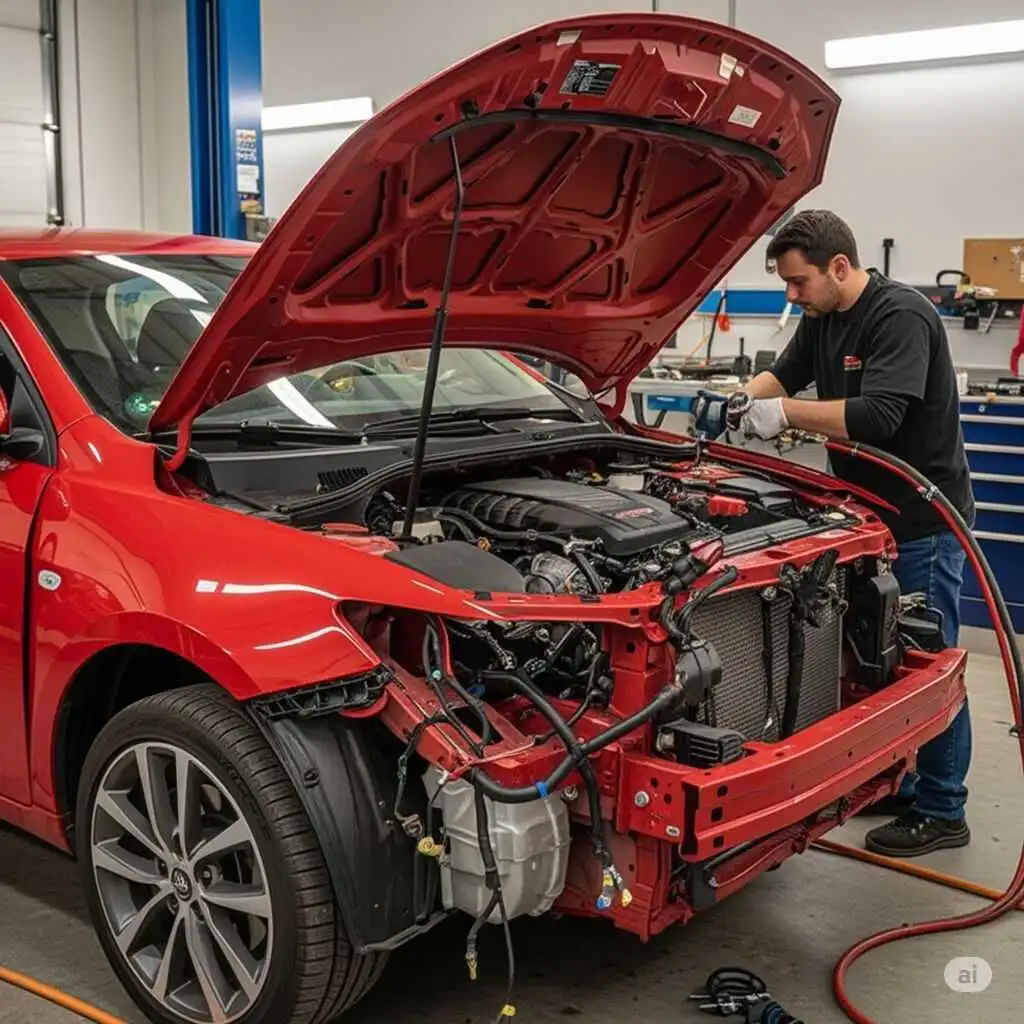
Unibody repair addresses damage to structural components integrated into the vehicle’s body assembly. Full-frame repair addresses damage to the separate supporting frame of a body-on-frame vehicle.
Both may involve structural measurement, permitted straightening, or component replacement, but the damaged parts, access requirements, attachment methods, and repair procedures differ.
The term “full-frame” describes how the vehicle is constructed. It does not automatically mean the entire frame requires replacement.
For an owner reviewing a collision estimate, the most useful question is: Which structural component is damaged, and what does the manufacturer’s repair information require?
A vehicle-specific unibody or full-frame repair assessment in Huntington Beach can identify the construction type, affected components, and applicable repair requirements.
Unibody vs. Full-Frame Repair at a Glance
| Comparison | Unibody repair | Full-frame repair |
|---|---|---|
| Basic construction | Body shell and structural members form an integrated assembly | Body mounts to a separate supporting frame |
| Common applications | Many passenger cars and crossovers | Many pickups and larger SUVs |
| Areas that may need repair | Rails, pillars, rockers, floor structure, reinforcements, and mounting areas | Frame rails, crossmembers, attachment points, and body-mount locations |
| Access considerations | Interior trim, adjacent panels, glass, or mechanical components may require removal | Body, bed, drivetrain, or attached systems may require removal |
| Possible repair methods | Permitted correction or structural component replacement | Permitted correction, approved section replacement, or complete frame replacement |
| Verification | Relevant structural dimensions and affected systems | Frame dimensions, body mounting, and affected systems |
Vehicle size and appearance do not reliably identify its construction. Confirm the design for the specific make, model, and year.
What Does Unibody Repair Involve?
Unibody repair addresses damaged structural areas built into the vehicle’s body assembly. There is no separate full-length supporting frame that can simply be removed from beneath the body.
Rails, pillars, rockers, reinforcements, floor sections, and mounting areas work together as part of the integrated structure. Damage in one location may therefore require inspection of adjoining components, joints, and attachment points.
Depending on the findings and manufacturer’s procedures, the work may involve:
- Correcting displacement where straightening is permitted.
- Replacing a damaged rail, reinforcement, pillar, or other structural component.
- Removing adjacent panels, trim, glass, or mechanical components for access.
- Restoring specified joints, seam sealers, coatings, and corrosion protection.
- Measuring relevant structural reference points during and after the repair.
“Unibody” does not mean the entire vehicle is one inseparable piece. Manufacturers may provide replacement procedures for individual structural components. The permitted sectioning locations, attachment methods, materials, and repair limits depend on the particular vehicle.
What Does Full-Frame Repair Involve?
Full-frame repair addresses damage to the separate frame that supports a body-on-frame vehicle. This frame typically includes longitudinal rails connected by crossmembers, with mounting points for the body, suspension, drivetrain, and other systems.
The inspection should determine whether the collision affected the frame, the body mounted above it, attached components, or a combination of these areas.
Depending on the vehicle and damage, the proposed work may include permitted straightening, replacement of an approved frame section, or complete frame replacement.
For example, GM has published instructions for installing a replacement front-frame service section on a specified heavy-duty pickup application. The procedure includes defined sectioning locations, three-dimensional measurement, welding, sealing and corrosion-protection operations. This document is an application-specific example—not a universal procedure for other GM trucks or body-on-frame vehicles. Current VIN-specific repair information should be reviewed before developing a repair plan.
A separate frame may make certain areas more accessible, but extensive repairs can still require substantial disassembly. The body, bed, suspension, or drivetrain may also have separate collision damage that requires evaluation.
Is a Subframe the Same as a Full Frame?
No. A subframe is a smaller supporting assembly that carries components such as the suspension, steering, engine, or drivetrain. Many unibody vehicles have a bolt-on front or rear subframe.
This distinction matters because “subframe replacement” and “full-frame repair” describe different operations.
A damaged bolt-on subframe may be replaceable while the surrounding unibody structure remains within specification. An impact may also damage both the subframe and the structural locations where it attaches.
Ask the shop to separate these findings:
- Is the subframe itself damaged?
- Are its mounting points displaced or damaged?
- Are attached steering or suspension components affected?
- Do the surrounding structural reference points require measurement?
Replacing a damaged subframe does not address separate damage to the structure supporting it.
How Do the Repair Methods Differ?
The primary differences involve how the vehicle is secured, which reference points are measured, and how technicians access and attach damaged components.
A unibody repair may require access to multiple joined layers around an integrated structural area. A full-frame repair may involve body mounts, crossmembers, brackets, and systems attached directly to the separate frame.
I-CAR provides separate full-frame and unibody training covering structural measurements, anchoring, pulling strategies, damage identification, and safety considerations.
Neither construction type makes every damaged part suitable for straightening. Material type, damage condition, component location, and manufacturer restrictions determine whether correction or replacement is appropriate.
To understand how anchoring, pulling and structural measurement work during an approved correction, read How Do Frame Straightening Machines Work Without Weakening the Steel?
At ER Collision and Auto Body Shop in Huntington Beach, we confirm the vehicle’s construction using its make, model, year, VIN, and applicable repair information. We then identify whether the damage involves the integrated unibody structure, a separate full frame, a bolt-on subframe, or a combination of components. When structural measurement is indicated, our Car-O-Liner computerized measuring equipment helps us evaluate the affected reference points and develop a vehicle-specific repair plan.
Does Unibody or Full-Frame Repair Cost More?
Neither construction type is consistently more expensive. The damaged components and required operations matter more than the construction label alone.
A localized unibody repair may cost less than complete truck-frame replacement, while damage involving several integrated structural areas may require extensive labor and refinishing.
For a complete breakdown of structural, mechanical, refinishing and verification expenses, read Car Frame Repair Cost in Huntington Beach.
Does One Type Take Longer to Repair?
Turnaround depends on the repair operations, access requirements, parts availability, and required verification—not simply whether the vehicle is unibody or body-on-frame.
Replacing an integrated structural component may involve disassembly, installation, sealing, corrosion protection, and refinishing. Complete-frame replacement may require transferring major components and systems to the replacement frame.
Ask whether the schedule is being controlled by disassembly, parts availability, structural work, refinishing, mechanical repairs, or final verification.
Time spent on structural equipment is only one part of the complete repair schedule. Any completion estimate may change if additional damage is discovered after disassembly or parts availability changes.
Is One Construction Type Safer After Repair?
Neither construction type is automatically safer or easier to restore. Both require repair methods appropriate to the vehicle, materials and collision damage.
The important questions are whether the manufacturer-supported procedure was followed and whether the completed repair was properly verified.
For the measurements and records used to evaluate completed structural work, read How Do You Know If a Shop Actually Fixed a Bent Frame Correctly?
What Should the Repair Estimate Tell You?
The estimate should identify the damaged structure and explain the proposed work clearly enough for you to understand the repair scope.
Before authorizing work, ask:
- Does my vehicle have unibody or body-on-frame construction?
- Which structural components are confirmed damaged?
- Which manufacturer procedures apply?
- What measurements and other records will document completion?
If the estimate says “full-frame repair,” clarify whether it means straightening a separate frame, replacing an approved section, or replacing the entire frame assembly. Those operations can differ significantly in parts, labor, access, and verification requirements.
How Can You Identify the Construction Type on an Estimate?
Look for the exact damaged component rather than relying on the general phrase “frame repair.”
| Estimate description | What it may refer to |
|---|---|
| Rail, rocker, pillar or floor section | Integrated unibody structure |
| Frame rail or crossmember | Separate body-on-frame structure |
| Front or rear subframe | Bolt-on supporting assembly |
| Body mount | Connection between a separate frame and body |
| Suspension mounting point | Area that may involve the subframe, body structure or separate frame |
Ask the estimator to identify the component on the vehicle and explain whether it is part of the body structure, a separate frame, or a removable subframe.
Get a Structural Repair Assessment in Huntington Beach
Contact Erik Reyna’s frame repair team—backed by 15+ years of collision repair experience and I-CAR Gold certification—to discuss your vehicle’s construction and collision damage.
Provide the VIN, collision photographs, and any existing estimate. Ask the team to identify the affected components, explain the proposed repair method, and clarify which findings may require further inspection after disassembly.
Call (714) 866-9453 to arrange an assessment at 17851 Jamestown Ln, Huntington Beach, CA 92647.