The New Eyes & Ears of Modern Cars
Modern vehicles aren’t just machines — they’re intelligent safety systems on wheels.
Every time your car automatically brakes, keeps you centered in a lane, or warns you of cross-traffic, it’s the result of Advanced Driver-Assistance Systems (ADAS) working in perfect harmony.
At ER Collision & Auto Body Shop in Huntington Beach, we specialize in repairing & recalibrating these highly sensitive sensors after accidents, even minor ones.
This guide explains the different types of ADAS sensors used in cars today, why they matter after a collision, & how we ensure each system functions safely before your car leaves our shop.
1. Radar Sensors — The Long-Range Safety Shield

Radar sensors use radio waves to measure distance & speed. They’re typically mounted behind the front grille or rear bumper.
Used in:
- Adaptive Cruise Control (ACC)
- Forward Collision Warning (FCW)
- Automatic Emergency Braking (AEB)
Collision-Repair Insight:
Even a light front-end impact or bumper repaint can slightly misalign the radar unit. That millimeter-shift could delay emergency braking or cause false alerts.
Our certified technicians perform static & dynamic radar calibration using OEM-specified targets to restore exact alignment.
2. Camera Sensors — The Vehicle’s Vision System

Cameras mounted near the windshield, grille, and mirrors interpret lane lines, signs, pedestrians, & other vehicles.
Used in:
- Lane Keep Assist (LKA)
- Traffic Sign Recognition (TSR)
- Pedestrian Detection
- Automatic High-Beam Control
Collision-Repair Insight:
Windshield replacement, suspension work, or even minor fender damage can tilt the camera by a fraction of a degree.
That’s enough to make your vehicle “see” a different lane than the one you’re driving in.
At ER Collision, we follow manufacturer procedures & provide a post-repair camera calibration report — ensuring every pixel aligns with factory safety tolerances.
3. Ultrasonic Sensors — The Parking and Blind-Spot Experts
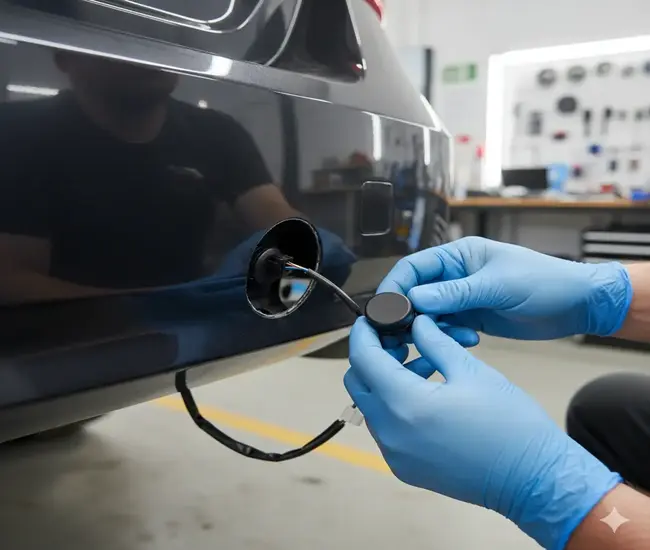
These short-range sensors use sound waves to detect nearby obstacles. They’re commonly embedded in front & rear bumpers.
Used in:
- Park Assist
- Rear Cross-Traffic Alert
- Blind Spot Detection
Collision-Repair Insight:
A repainted or replaced bumper can distort the sensor’s signal. Even heavy clear-coat can cause echo interference, making your parking alerts unreliable.
We test & recalibrate each ultrasonic sensor individually after every bumper repair or replacement.
4. LiDAR Sensors — The Laser-Sharp 3D Mappers

LiDAR (Light Detection & Ranging) uses laser pulses to build a 3D map of your surroundings.
You’ll find them in advanced vehicles (Tesla, Audi, Volvo) & newer electric models.
Used in:
- Collision Avoidance
- Autonomous Driving Features
- Pedestrian Recognition
Collision-Repair Insight:
Because LiDAR units project light beams, even tiny alignment errors or dirt on the housing can cause blind spots.
Our team measures and adjusts LiDAR angles with precision OEM calibration tools — restoring full system accuracy.
5. Infrared / Night-Vision Sensors — Seeing Beyond Headlights

Infrared sensors detect heat signatures of pedestrians, cyclists, or animals in low-light conditions.
They’re usually mounted behind the grille or in the front bumper.
Used in:
- Night Vision Assist
- Pedestrian Collision Warning
Collision-Repair Insight:
Infrared sensors require a completely clear line of sight.
Even a misaligned bumper grille or aftermarket part can block or scatter heat readings — putting nighttime safety at risk.
6. GPS / GNSS & V2X Sensors — The Connected Car’s Brain
The newest generation of ADAS vehicles use Global Navigation Satellite Systems (GNSS) & Vehicle-to-Everything (V2X) communication sensors.
These help your vehicle share data with nearby cars, traffic lights, & road infrastructure.
Used in:
- Real-Time Navigation
- Vehicle-to-Vehicle Safety Alerts
- Autonomous Driving Support
Collision-Repair Insight:
After any body or roof repair, recalibration & software updates are crucial to maintain synchronization between your vehicle’s sensors & the network.
Our ADAS calibration specialists verify GPS antenna alignment & perform post-repair communication tests.
Why Calibration After a Collision Is Non-Negotiable
Every ADAS sensor relies on millimeter-perfect positioning.
Because collisions often affect suspension, steering, and alignment components, mechanical geometry must be verified before ADAS calibration. Even when sensors themselves aren’t damaged, improper ride height or wheel alignment can cause radar & camera systems to misinterpret distance, lanes, or objects.
That’s why ER Collision Auto Body Shop performs in-house suspension & alignment checks as part of the ADAS calibration process.
Even a gentle fender-bender, windshield replacement, or repaint can throw off your vehicle’s safety systems — often without triggering a dashboard warning light.
At ER Collision & Auto Body Shop, we follow strict manufacturer calibration standards to guarantee every sensor works exactly as intended.
Our ADAS Calibration Includes:
- Pre-repair diagnostic scan
- Static & dynamic calibration using OEM-approved tools
- Full calibration documentation for insurance claims
- Post-repair verification drive
Typical ADAS Calibration Costs in Huntington Beach
| Sensor Type | Average Cost (Per System) | Time Required |
| Radar | $300 – $600 | 1–2 hrs |
| Camera | $250 – $500 | 1–1.5 hrs |
| Ultrasonic | $100 – $250 | 0.5 – 1 hr |
| LiDAR | $400 – $800 | 2 hrs + |
| Infrared | $200 – $400 | 1 hr |
| GPS/V2X | $250 – $600 | 1–2 hrs |
Further, we provide free estimates upon inspection.
Frequently Asked Questions (FAQs)
Q: What are the main types of ADAS sensors in modern cars?
A: Most vehicles use radar, camera, ultrasonic, LiDAR, infrared, & GPS/V2X sensors. Together, they enable advanced safety features like braking, lane-assist, & blind-spot monitoring.
Q: Do all ADAS sensors need recalibration after a collision?
A: Yes — whenever sensors or the components housing them are repaired, replaced, or repainted.
Q: How do I know if an ADAS sensor is misaligned?
A: Warning lights, false alarms, or missing safety alerts can indicate misalignment — but sometimes no warning appears until failure occurs. A post-repair diagnostic scan is essential.
Q: Can aftermarket bumpers or parts interfere with ADAS sensors?
A: Absolutely. Aftermarket parts may not match OEM material thickness or mounting points, causing radar or camera interference. ER Collision always recommends & installs OEM parts.
Q: How often should sensors be checked or cleaned?
A: Clean sensors regularly and have them inspected during routine maintenance or after any impact — even curb or parking-lot bumps.
Q: Will my insurance cover ADAS calibration in Huntington Beach?
A: Yes, most carriers cover it if properly documented. We handle insurance claim assistance & provide full calibration reports referencing manufacturer requirements.
Q: What areas do you serve?
Based in Huntington Beach, we proudly serve Costa Mesa, Irvine, Fountain Valley, Newport Beach, Westminster & surrounding Orange County.
Why Huntington Beach Drivers Trust ER Collision
- I-CAR Gold Certified Technicians: Expertise in all makes & models, including EVs & luxury vehicles.
- OEM Parts Only: Guaranteed fit & sensor alignment accuracy.
- Insurance Claim Assistance: We advocate on your behalf to ensure calibration is covered.
- Lifetime Warranty on All Repairs: Your safety systems remain reliable long after you leave our shop.
- Free Pickup & Delivery within 5 Miles & Rental car assistance
- Full-service collision shop offering bumper repair, PDR, towing, fleet repairs, detailing, and insurance claim assistance
Closing CTA
If your vehicle has been in an accident — even a minor one — make sure every ADAS sensor is properly inspected & recalibrated.
At ER Collision & Auto Body Shop, we combine cutting-edge calibration tools, OEM data, & certified expertise to restore your vehicle’s full safety functionality.
17851 Jamestown Ln, Huntington Beach, CA 92647
(714) 866-9453
Book Your Free ADAS Calibration Estimate Today