To file an auto insurance claim after an accident in California, notify the appropriate insurer promptly, provide the basic accident and vehicle details, submit available evidence, and obtain a claim number and adjuster’s contact information.
You do not need to know the final repair cost or have every document before reporting the accident. Opening the claim allows the insurer to begin its investigation and explain what information it still needs.
Reporting an accident opens the insurance claim. It does not determine fault, approve repairs, or authorize an auto body shop to begin work.
If you are still handling the immediate steps after the collision, see What to Do After a Car Accident in Huntington Beach.
1. Decide Which Insurance Company to Contact
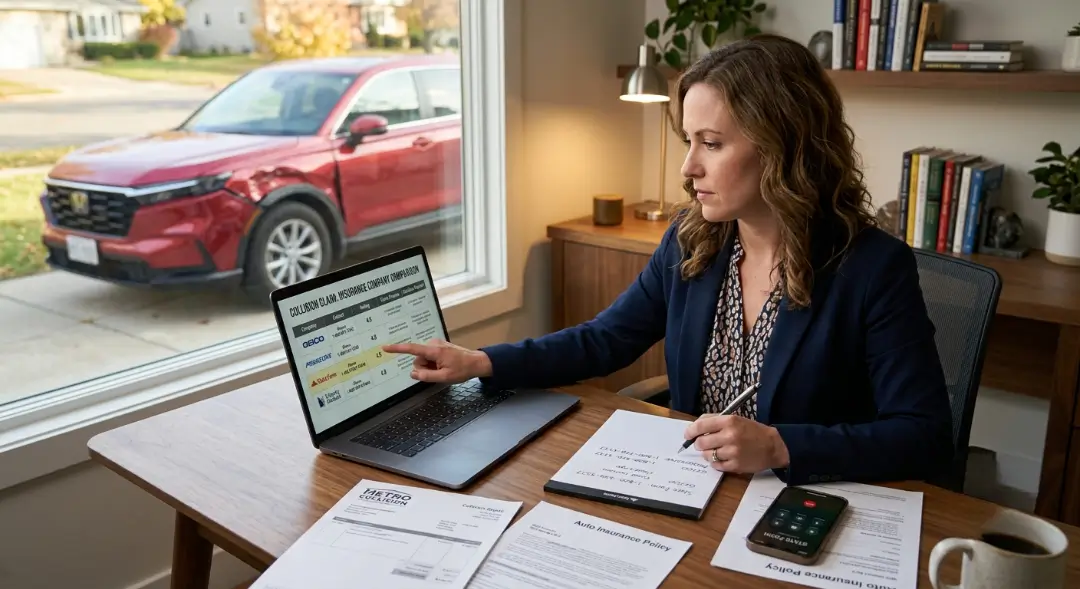
The first step is deciding whether to file through your own insurer, the other driver’s insurer, or notify both.
First-party claim
A first-party claim is filed under your own policy. Collision coverage may apply to damage to your vehicle, subject to the policy terms and deductible.
Your insurer may later attempt to recover payment from another responsible party or insurer. Recovery of your deductible is not guaranteed.
Third-party claim
A third-party claim is made against another driver’s liability insurer.
You generally do not pay your policy deductible when another insurer accepts responsibility and pays the vehicle-damage claim. However, that insurer will investigate fault, coverage, and the amount of damage before agreeing to pay.
Even when you believe another driver caused the accident, notify your own insurer promptly when required by your policy. Your insurer can explain whether collision, rental, medical-payments, uninsured-motorist, or other coverage may be available.
If you are concerned about the effect on your premium, see How Much Does Car Insurance Go Up After an Accident in California?
2. Report the Accident Promptly
California’s Department of Insurance advises drivers to notify their insurance agent or company immediately after an accident.
You can usually open a claim through:
- The insurer’s claims telephone number
- Its website
- Its mobile application
- Your insurance agent
Be prepared to provide:
- Your name and contact information
- Your policy number, when using your insurer
- The accident date, time, and location
- The names of the involved drivers
- Whether anyone reported an injury
- Whether the vehicle can be driven
- The vehicle’s current location
- The responding police agency and report number, when available
Do not delay opening the claim because you are waiting for a police report, repair estimate, towing invoice, or complete set of photographs. Tell the insurer which documents are still pending.
3. Obtain the Claim Information
Before ending the initial report, obtain:
- The claim number
- The assigned adjuster’s name
- The adjuster’s telephone number and email address
- Instructions for submitting documents
- The expected next step
- The expected follow-up timeframe
- Keep this information with your accident records.
When speaking with the insurer, ask whether the claim requires:
- A recorded or written statement
- Additional photographs
- A vehicle inspection
- A copy of the police report
- Towing or storage documents
- Repair estimates
- Rental-vehicle documentation
Do not assume the insurer has received a document merely because another person, repair facility, or towing company said it was sent.
4. Submit Evidence That Supports the Claim
The insurer may request information showing how the accident occurred and the nature and amount of the loss.
Useful materials may include:
- Photographs of each vehicle
- Wide photographs of the accident location
- Driver and vehicle information exchanged at the scene
- Witness names and contact details
- Towing and storage receipts
- Medical documentation when an injury claim is involved
- Earlier photographs or repair records when pre-existing damage is questioned
Send copies rather than your only originals whenever possible.
Label documents clearly. Identify the vehicle, damaged area, date, or expense connected to each item so the adjuster can understand its purpose.
Keep a record of when and how the documents were submitted.
5. Describe the Accident Without Guessing
When reporting the collision, describe only what you personally observed.
Relevant facts may include:
- Where each vehicle was traveling
- The direction of travel
- Traffic signals or signs
- Lane positions
- The point of impact
- What happened immediately before the collision
- What happened immediately afterward
Do not guess about:
- Another driver’s speed
- Distraction or intoxication
- Mechanical failure
- Injury severity
- Distance or timing you cannot accurately recall
- What another person intended to do
Avoid arguing about fault, promising to pay another person’s damages, or signing a statement you do not understand.
You should cooperate with reasonable requests from your insurer under the policy.
When the accident involves injuries, disputed responsibility, several vehicles, commercial use, or possible litigation, consider obtaining qualified legal advice before signing a release or providing a statement you do not fully understand.
6. Ask How the Vehicle Will Be Inspected
After opening the claim, ask the adjuster how the vehicle inspection will be completed. The insurer may inspect the vehicle in person, request photographs, conduct a virtual inspection, or review an estimate from a collision repair facility.
An insurance inspection or estimate does not automatically authorize repairs. Before allowing work to begin, confirm what the insurer has reviewed and what you have authorized.
Learn more in What Happens After an Insurance Adjuster Inspects Your Car in California?
7. Keep a Written Claim Record
Keep the claim number, adjuster’s contact information, submitted documents, inspection dates, estimates, written decisions, and claim-related expenses in one place.
After an important telephone call, send a short follow-up email confirming what was discussed, what information is still needed, who is responsible for the next step, and when you should expect an update.
A written record can help prevent delays and confusion during the claim process.
8. Understand California Claim-Response Timelines
After receiving notice of a claim, a California insurer generally must acknowledge the claim, begin any necessary investigation, provide required forms and instructions, and offer reasonable assistance within 15 calendar days.
The insurer must also generally respond within 15 calendar days to communications that reasonably require a response.
California’s fair-claims regulations generally require an insurer to accept or deny a claim, in whole or in part, within 40 calendar days after receiving proof of claim, subject to applicable exceptions and documented extensions.
Proof of claim means evidence supporting the existence and amount of the loss. It does not necessarily mean the date when the accident was first reported.
These are claim-handling timelines. They do not guarantee that the vehicle will be repaired or the entire claim will be completed within the same period.
When a response is overdue or unclear, ask in writing:
What information or decision is currently outstanding, and what is the next step?
9. File a California DMV Report When Required
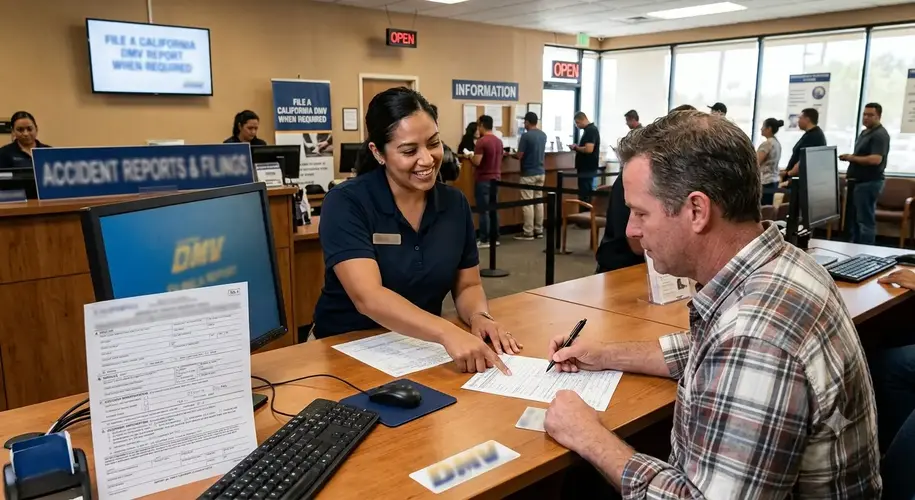
An insurance claim and a California DMV accident report are separate.
Each involved driver generally must file a California DMV Form SR-1 within 10 days when:
Anyone was injured or killed, even when the injury appeared minor; or
The accident caused more than $1,000 in property damage.
The requirement generally applies regardless of who caused the accident and applies even when the collision occurred on private property.
A police report does not replace the driver’s separate SR-1 responsibility.
Filing the SR-1 does not open an insurance claim, determine fault, approve coverage, or authorize repairs.
Frequently Asked Questions
Can ER Collision and Auto Body Shop open my insurance claim?
The customer should report the accident to the appropriate insurance company and obtain a claim number. ER Collision and Auto Body Shop can then assist with the repair-related portion of the claim.
What information should I obtain when opening the claim?
Ask for the claim number, adjuster’s name and contact information, document-submission instructions, vehicle-inspection requirements, and the next expected step.
How can ER Collision and Auto Body Shop help after the claim is opened?
The shop can inspect and photograph the damage, prepare and review repair estimates, submit supplemental repair information, communicate with the adjuster, coordinate direct billing, and complete customer-authorized repairs.
What happens if additional damage is discovered?
ER Collision and Auto Body Shop can document the additional damage and submit a supplemental estimate for the insurer’s review. The insurer determines coverage, and the customer must authorize any additional repairs.
Claim Opened? Let ER Collision Handle the Repair Side

Once you have a claim number, Erik Reyna & his team at ER Collision and Auto Body Shop can help with the next repair-related steps—from documenting collision damage and reviewing the insurer’s estimate to preparing supplements, communicating with the adjuster, coordinating insurance billing, and completing authorized repairs.
See how our Auto Insurance Claim Assistance service can help simplify the repair process in Huntington Beach and Orange County.
This guide provides general information about filing an auto insurance claim in California. ER Collision & Auto Body Shop assists with repair documentation and claim-related repair coordination but does not determine fault, coverage, approval, or payment.