If an insurance company approves less than the repair facility says the accident repairs will cost, do not immediately assume you must pay the entire difference.
The unpaid amount may be:
- Included in a supplement still under review
- Waiting for additional documentation
- Formally disputed or denied
- Your policy deductible
- Limited or excluded by the policy
- Related to pre-existing damage
- Connected to optional work you authorized
Your first step is to identify the exact repair item that remains unpaid and determine its current status.
A pending supplement is not the same as a final denial.
Before authorizing work, confirm whether each major difference is approved, pending, denied, excluded, or expected to become your responsibility.
1. Identify the Exact Unpaid Repair Item
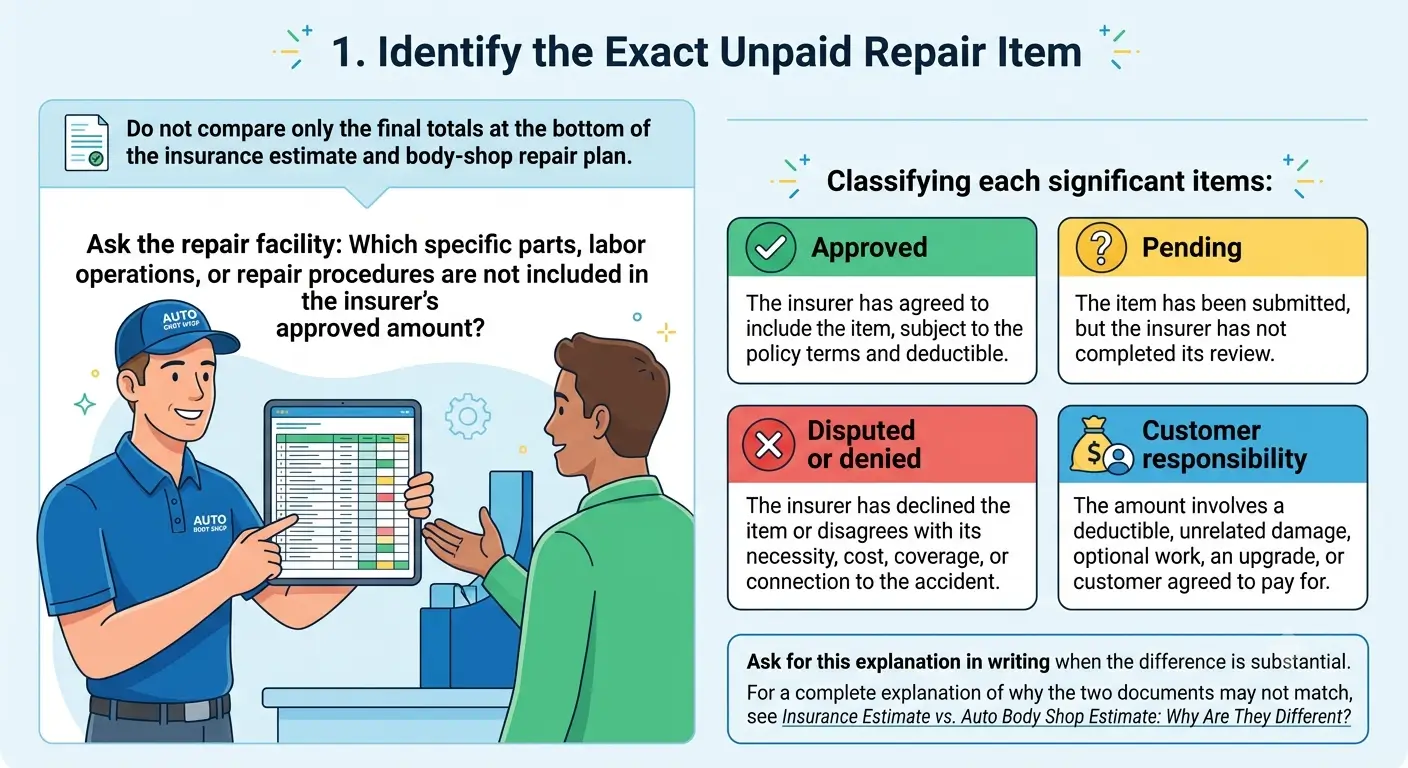
Do not compare only the final totals at the bottom of the insurance estimate and body-shop repair plan.
Ask the repair facility:
Which specific parts, labor operations, or repair procedures are not included in the insurer’s approved amount?
The shop should classify each significant item as:
Approved
The insurer has agreed to include the item, subject to the policy terms and deductible.
Pending
The item has been submitted, but the insurer has not completed its review.
Disputed or denied
The insurer has declined the item or disagrees with its necessity, cost, coverage, or connection to the accident.
Customer responsibility
The amount involves a deductible, unrelated damage, optional work, an upgrade, or work the customer agreed to pay for.
Ask for this explanation in writing when the difference is substantial.
For a complete explanation of why the two documents may not match, see Insurance Estimate vs. Auto Body Shop Estimate: Why Are They Different?
2. Confirm Whether a Supplement Was Submitted
An insurer’s initial estimate may be based on photographs or damage visible during the first inspection.
When the repair facility discovers additional accident-related damage or identifies necessary work that was not included, it may prepare a supplemental estimate.
Ask:
- When was the supplement submitted?
- Did the insurer confirm receiving it?
- Which repair items are included?
- Is additional documentation required?
- Will the insurer reinspect the vehicle?
- Which items remain undecided?
- Who is responsible for the next step?
A supplement may include photographs, measurements, parts information, diagnostic results, repair procedures, or an explanation of why a component must be repaired or replaced.
Additional documentation does not guarantee approval. It should directly support the specific repair item under review.
3. Determine Whether the Item Is Pending or Formally Denied
Before disputing the insurer’s decision, confirm that a final decision has actually been made.
A repair item may be:
- Waiting for adjuster review
- Waiting for supporting evidence
- Scheduled for reinspection
- Being discussed with the repair facility
- Formally denied or rejected
Ask the adjuster:
Has the insurer made a final decision on this repair item, or is it still pending review?
If the item remains pending, request:
- The missing information
- The person responsible for reviewing it
- The expected next step
- The anticipated decision date
If the item has been formally denied, request the insurer’s position in writing.
4. Request the Basis for a Denial
When an insurer denies or disputes part of a claim, ask for a clear explanation of the decision.
Request:
- The exact part or operation being denied
- The factual reason for the decision
- The applicable policy, legal, or coverage basis
- An explanation of how that provision applies
- Whether additional evidence could change the decision
- The process for requesting further review
A statement such as “we do not pay for that” does not explain whether the issue involves:
- Coverage
- Repair necessity
- Pricing
- Documentation
- Parts selection
- Accident relationship
- A policy limitation
Keep the insurer’s written explanation with the repair estimate, supplement, and supporting documentation.
5. Confirm What You May Personally Owe
The customer is responsible for authorizing repairs with the repair facility. Insurance payment decisions and repair authorization are separate.
California repair facilities generally must provide an estimate and obtain the customer’s authorization before beginning work. Added repairs and increased charges may also require additional authorization.
Before signing an estimate or revised authorization, ask:
If the insurer does not approve this amount, will I be personally responsible for it?
You may be responsible for part of the repair when the amount involves:
- Your collision or comprehensive deductible
- Pre-existing damage
- Damage unrelated to the accident
- Optional cosmetic work
- Upgraded parts or materials
- A policy exclusion or coverage limitation
- Work authorized before payment was confirmed
Ask the repair facility to identify any possible customer responsibility in writing.
Do not assume that every item on the shop’s repair plan will be paid simply because an insurance claim is open.
6. Compare the Insurer’s Decision With the Supporting Evidence
For each unresolved item, organize the relevant documents.
These may include:
- The insurer’s estimate
- The repair facility’s estimate
- The supplemental estimate
- Photographs of the damage
- Structural measurements
- Diagnostic scan results
- Calibration requirements
- The insurer’s written position
The documentation should address the exact disputed item.
For example, when an insurer questions whether a damaged component is related to the accident, the supporting information should explain where the damage is located and how it connects to the collision.
Avoid sending a general complaint that the estimate is “too low” without identifying the specific lines under review.
7. Ask for Supervisor Review
When the repair facility has provided supporting documentation and the issue remains unresolved, request review by a claim supervisor or manager.
Send one organized package containing:
- The disputed repair item
- The amount involved
- The shop’s explanation
- Supporting photographs or records
- The insurer’s written position
- The reason you are requesting reconsideration
Use a direct request such as:
Please review the attached documentation for the disputed repair item and provide the insurer’s written decision and basis.
Ask the supervisor to confirm receipt and identify whether any additional information is needed.
Keep a record of all telephone calls, emails, documents, and response dates.
8. Understand First-Party and Third-Party Differences
The next step may depend on which insurer is handling the vehicle-damage claim.
First-party claim
A first-party claim is made under your own collision or comprehensive coverage.
Your deductible may apply. Ask whether the item is pending, excluded, or formally denied under your policy.
When an item is denied, request the policy provision or coverage basis supporting the decision.
Third-party claim
A third-party claim is made against another driver’s liability insurer.
When you pursue a vehicle-damage claim directly through another driver’s liability insurer, your own policy deductible generally is not applied to that third-party payment. The insurer may still investigate responsibility, coverage, and the amount of the loss before making payment.
However, disputes over fault, comparative responsibility, coverage limits, or the amount of damage may affect payment.
Ask for the insurer’s written position regarding the disputed repair amount.
In either type of claim, begin with the same question:
Which exact repair item is unpaid, what is its current status, and why has it not been approved?
9. Escalate Claim-Handling Concerns When Appropriate
When you believe an insurer has not followed applicable California claim-handling requirements, you may exercise your rights under California Insurance Code Section 12921.3 and request assistance from state regulators.
Its Consumer Services Division accepts complaints involving concerns such as:
- Improper claim denials
- Unexplained delays
- Failure to respond
- Inadequate written explanations
- Other claim-handling issues
A complaint does not guarantee approval of every repair item or a particular payment. It allows the Department to review how the insurer handled the matter.
Consider consulting a qualified California attorney when the dispute involves:
- A substantial unpaid amount
- Policy coverage
- Bodily injuries
- Alleged bad faith
- Possible litigation
- A release or settlement you do not understand
Does Choosing Your Own Repair Shop Cause the Difference?

Choosing your own collision repair facility does not automatically cause an estimate difference.
California law generally prohibits an insurer from requiring a vehicle to be repaired at one specific automotive repair dealer.
However, choosing your own shop does not mean the insurer must automatically approve every item on its repair plan. The facility may still need to show that the requested work is accident-related, necessary, documented, and covered.
For a complete explanation of shop-selection rights, see Can You Choose Your Own Collision Repair Shop in California?
Frequently Asked Questions
What should I do if insurance approves less than the body shop estimate?
Ask the repair facility which specific parts, labor operations, or procedures remain unpaid and whether they are approved, pending, disputed, or your responsibility.
Does a pending supplement mean the insurer denied the repair?
No. A pending supplement means the insurer is still reviewing additional repair documentation or damage. It is not the same as a final denial.
Can I be responsible for part of the repair cost?
Yes. You may be responsible for your deductible, pre-existing or unrelated damage, optional work, upgrades, policy exclusions, or work authorized before insurance payment was confirmed.
Can I ask the insurance company to reconsider a denied repair item?
Yes. Request the insurer’s written reason for the denial and submit documentation supporting the specific disputed repair item. You may also request review by a claims supervisor.
Insurance Estimate Lower Than the Repair Plan?
ER Collision & Auto Body Shop can review the insurer’s estimate, identify unresolved repair items, document additional accident-related damage, prepare supplemental repair information, and communicate repair-related technical details to the adjuster.
Learn more about our Auto Insurance Claim Assistance services for Huntington Beach and Orange County drivers.
This article is for general informational purposes only and is not legal, insurance, or financial advice. ER Collision & Auto Body Shop does not determine coverage or payment and cannot guarantee approval of any repair, supplement, or additional claim amount.